

TL;DR:
- Effective website maintenance involves balancing corrective, preventive, evolutionary, content, and SEO work. Providers who focus only on fixing issues reactively face higher long-term costs and site instability. Proper scheduling and separation of these tasks ensure a site’s security, functionality, and growth.
Website maintenance falls into five distinct categories: corrective, preventive, evolutionary, content, and SEO. Each type addresses a different aspect of keeping a site secure, functional, and performing well. Understanding these types of site maintenance is not optional for agencies managing WordPress on behalf of clients. It is the difference between a site that earns its keep and one that quietly drains your team’s time and your client’s budget.
1. What is corrective maintenance and when should you apply it?

Corrective maintenance is the reactive work triggered when something breaks. It covers bug fixes, broken links, display errors, failed form submissions, and any fault that stops the site working as intended. The trigger is always an identified problem, not a schedule.
Common corrective tasks include:
- Fixing 404 errors and broken internal links
- Resolving plugin conflicts after an update
- Repairing contact forms or checkout flows
- Correcting layout breaks on specific devices or browsers
- Restoring content lost after a failed update
The financial risk of corrective maintenance is its unpredictability. Corrective work is reactive and unplanned, which means it arrives as a budget spike rather than a scheduled cost. For agencies, that usually means absorbed hours and an awkward conversation with the client.
Pro Tip: Log every corrective fix in a shared tracker. Patterns in that log reveal which plugins, themes, or hosting configurations cause the most breakage. That data justifies a preventive maintenance plan to the client and reduces future emergency calls.
Speed matters with corrective work. A broken checkout or a failed contact form costs the client revenue by the hour. Prioritise triage and resolution over documentation in the moment, then document afterwards.
2. How does preventive maintenance keep your site secure and stable?
Preventive maintenance is planned, scheduled work designed to stop problems before they occur. It is the most cost-effective type of website upkeep because it converts unpredictable emergency fixes into planned, manageable costs.
A standard preventive schedule looks like this:
- Weekly: Automated backups, uptime monitoring, security scans
- Monthly: WordPress core, plugin, and theme updates; review of error logs
- Quarterly: SSL certificate checks, performance audits, database optimisation
- Annually: Full site review, hosting review, accessibility audit
One of the most overlooked preventive practices is following the 3-2-1 backup rule: keep three copies of your data, on two different media types, with one copy stored off-site. Backup tests regularly reveal restoration failures that would be catastrophic in a real crisis.
Maintenance drift is the hidden enemy here. When minor updates are skipped for weeks or months, technical debt accumulates. What should be a five-minute plugin update becomes a two-hour compatibility investigation. Consistent small updates prevent that compounding effect.
Pro Tip: Never update plugins on a live site without a staging environment. Run updates on staging first, check for conflicts, then push to production. This single habit eliminates the majority of corrective emergencies.
For agencies managing multiple client sites, preventive maintenance is the foundation of a recurring revenue model. It is predictable, deliverable, and genuinely valuable to the client.
3. Evolutionary maintenance: adapting your site to business growth
Evolutionary maintenance adds new capability to a site. It is not fixing what is broken or preventing future breakage. It is building what does not yet exist. This type of work is driven by business change, not technical failure.
Typical evolutionary tasks include:
- Adding new service or product pages as the business grows
- Integrating a CRM, booking system, or payment gateway
- Building out a blog or resource section to support content marketing
- Migrating to a faster hosting environment as traffic increases
- Restructuring navigation as the site’s content depth grows
The distinction from corrective and preventive work matters for scoping and pricing. Evolutionary maintenance is development work. It should be scoped, quoted, and delivered as a project, not absorbed into a care plan. Agencies that blur this line end up doing development work at maintenance rates.
WordPress requires heavier, more frequent updates than managed platforms, which means evolutionary changes on WordPress carry more integration risk. A new plugin that conflicts with an existing one can trigger corrective work immediately after an evolutionary change. Planning for that overlap protects both the agency and the client.
4. Content maintenance: why updating your site’s information matters
Content maintenance is the most frequently neglected of all the types of website care. It covers updating text, images, offers, team pages, testimonials, and any information that becomes outdated. Neglecting content maintenance directly harms visitor engagement and search engine rankings.
A monthly content maintenance review should cover:
- Updating team pages after new hires or departures
- Refreshing service descriptions when offerings change
- Correcting pricing, dates, or promotional details
- Adding new case studies or client testimonials
- Checking that all calls to action link to live, relevant pages
Stale content signals to both visitors and search engines that a site is not actively managed. A prospect who sees a “Meet the Team” page featuring someone who left two years ago loses confidence in the business immediately. That is a conversion lost to neglect, not to competition.
Regular content updates keep the site relevant and support search rankings by demonstrating that the site is actively maintained. For agencies, content maintenance is also an easy upsell. Clients rarely have the time or discipline to do it themselves, and the value is visible and tangible.
5. How SEO maintenance preserves your site’s search visibility
SEO maintenance is the scheduled technical and content work that protects and improves a site’s position in search results. Page speed is a confirmed ranking factor, and proactive maintenance prevents the technical failures that erode organic traffic over time.
Core SEO maintenance tasks, run monthly to quarterly, include:
- Reviewing and fixing errors flagged in Google Search Console
- Auditing and updating page titles, meta descriptions, and heading structures
- Checking and improving internal linking between related pages
- Running Core Web Vitals audits and addressing performance issues
- Identifying and redirecting broken or outdated URLs
| Task | Frequency |
|---|---|
| Search Console error review | Monthly |
| Metadata audit | Quarterly |
| Internal linking review | Quarterly |
| Core Web Vitals audit | Monthly |
| Broken URL check and redirect | Monthly |
SEO maintenance sustains search visibility and supports traffic growth over time. Without it, even a well-built site loses ground to competitors who are actively maintaining theirs. For agencies, this is one of the strongest arguments for a structured website maintenance plan: the client’s organic traffic is a measurable business asset, and maintenance protects it.
If you manage WordPress sites for multiple clients, use the WordPress Profit Calculator to see exactly how much uncaptured revenue is sitting in your existing client base. It takes under 90 seconds and the results are usually surprising.
Key takeaways
Effective website upkeep requires all five maintenance types working together: corrective, preventive, evolutionary, content, and SEO.
| Point | Details |
|---|---|
| Five maintenance types | Corrective, preventive, evolutionary, content, and SEO each address a distinct aspect of site health. |
| Preventive work reduces cost | Planned maintenance converts unpredictable emergency fixes into scheduled, budgeted tasks. |
| Content neglect harms rankings | Outdated team pages, offers, and descriptions damage both visitor trust and search performance. |
| SEO maintenance is ongoing | Monthly Search Console reviews and Core Web Vitals audits protect organic traffic from gradual erosion. |
| Maintenance drift is costly | Skipping minor updates compounds technical debt, making future fixes significantly more expensive. |
Why I think most agencies are solving maintenance in the wrong order
Most agencies I speak to treat corrective maintenance as the default. Something breaks, they fix it. That reactive pattern feels normal because it is visible and urgent. The client calls, the team responds, the problem gets solved. It looks like good service.
The problem is that corrective-first thinking is expensive and exhausting. Every emergency fix is a cost that was not planned for, a conversation that should not have been necessary, and a signal that the site was not being looked after properly. Maintenance is a continuous process, not a response to crisis. Agencies that understand this shift from firefighting to structured care plans, and their margins improve immediately.
The other mistake I see is treating all five maintenance types as one undifferentiated blob of “website work.” Evolutionary maintenance is development. It should be scoped and priced as such. Content maintenance is editorial. SEO maintenance is technical marketing. Bundling them all into a flat monthly retainer undervalues the work and makes it impossible to show the client what they are actually getting.
My practical advice: build a maintenance schedule that covers preventive and SEO tasks on a fixed cadence, handle corrective work within a defined response SLA, and price evolutionary work separately as project scope. That structure protects your team, gives the client clarity, and makes the value of professional WordPress maintenance visible every single month.
— Marcel
Wpcto handles the maintenance so your agency does not have to
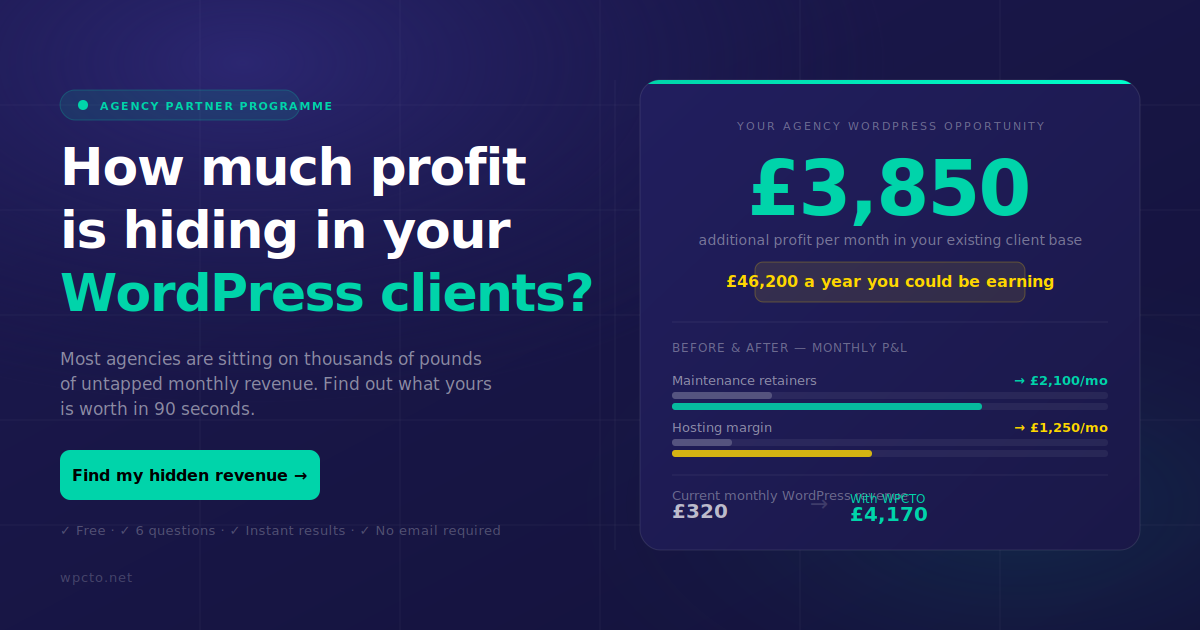
Wpcto is a specialist WordPress maintenance and support service built for design, brand, and digital agencies in the UK. We handle security monitoring, plugin and theme management, performance audits, backups, and emergency support, all delivered under your agency’s brand if you prefer. Your clients get expert WordPress care. Your team gets their time back. If you want to see how much recurring revenue your existing WordPress client base could generate, the WordPress Profit Calculator gives you a clear answer in under 90 seconds. To explore how we work with agencies, visit our agency services page.
FAQ
What are the five types of site maintenance?
The five types are corrective, preventive, evolutionary, content, and SEO maintenance. Each addresses a different aspect of keeping a website secure, functional, and performing well.
How often should website maintenance be carried out?
Preventive tasks like backups and monitoring run weekly, while plugin updates and SEO checks are monthly. Performance and SSL audits are quarterly, with a full site review annually.
What is the difference between corrective and preventive maintenance?
Corrective maintenance fixes problems after they occur. Preventive maintenance is scheduled work that stops problems from occurring in the first place, reducing long-term costs significantly.
Why does content maintenance affect SEO?
Search engines treat regularly updated content as a signal of an actively managed site. Outdated pages, broken calls to action, and stale team information all reduce both visitor trust and search rankings.
What is maintenance drift?
Maintenance drift occurs when minor updates are repeatedly skipped, causing technical debt to accumulate. When updates are finally applied, the compatibility work required is far more complex and costly than it would have been if done consistently.