

There are four types of industrial maintenance in everyday use: corrective (run-to-failure), preventive (scheduled), predictive (condition-based) and reliability-centred maintenance, which decides which of the other three each asset gets. Most plants use a mix. The skill lies in matching the method to the risk and cost of each asset.
We should be clear about who we are. We are a WordPress management service for UK design, brand and digital agencies, not an engineering contractor, and we do not service factory equipment. But the maintenance framework that engineers use is the best mental model we know for running WordPress client portfolios. So this guide covers the industrial types properly, including the UK legal duty behind them, and then shows how agency owners can apply the same logic to the websites they look after.
TL;DR
- Industrial maintenance falls into corrective, preventive, predictive and reliability-centred approaches, usually blended across a site.
- In the UK, PUWER 1998 requires employers to keep work equipment maintained, so “run it until it breaks” is not an option for safety-critical kit.
- Not every asset deserves the same schedule. Risk and function should drive the plan, not habit.
- The same four-way split maps neatly onto WordPress care: emergency fixes, scheduled updates, monitoring, and a risk-based plan per client.
- If you run an agency, our WordPress Profit Calculator shows in under 90 seconds how much uncaptured revenue sits in your client base.
Table of Contents
- What industrial maintenance actually covers
- The four main types of industrial maintenance
- Comparing the types at a glance
- The UK legal backdrop: PUWER
- Design decides more than maintenance does
- Applying the four types to WordPress client sites
- Where the revenue is hiding
- Perspective: why we think in tiers, not tickets
- Choosing a maintenance mix for your client base
- Work with us behind your agency
- FAQ
- Sources
What industrial maintenance actually covers
The HSE describes maintenance of plant and equipment as work carried out to prevent problems arising, put faults right and keep equipment working effectively. It may be a planned programme, or it may have to happen at short notice.
That definition already contains the main split: planned work and reactive work. Everything else in the field is a refinement of how you plan, when you trigger work, and how you decide what deserves attention.
In practice, industrial maintenance includes inspection, lubrication, repair, replacement and condition monitoring across machinery, electrical systems, building services and process lines. The types below describe the strategy behind that work.
The four main types of industrial maintenance
Corrective (breakdown or run-to-failure) maintenance
You act after something fails. Sometimes this is a deliberate choice: a light fitting or a low-cost, easily replaced part with no safety consequence may simply be run until it dies. Often, though, it is the default by neglect.
The upside is no upfront planning cost. The downside is unplanned downtime, rushed repairs, and failures that happen at the worst moment. For anything that can injure someone or stop a production line, it is the wrong primary strategy.
Preventive (scheduled) maintenance
Work is done at fixed intervals, by calendar or by running hours, regardless of the asset’s current condition. Think of a motor manufacturer’s service schedule. A Siemens motor manual, for example, warns that trouble-free operation cannot be expected if proper maintenance is postponed or neglected.
Preventive maintenance is simple to schedule and audit. Its weakness is that it can over-maintain. A thesis from Brunel University on equipment reliability cites Nowlan and Heap’s conclusion that time-based maintenance works for only a small percentage of components, and then only with solid wear-out data.
Predictive (condition-based) maintenance
You monitor the asset and act when the data says so: vibration, temperature, oil condition, current draw. The aim is to intervene just before failure, not before and not after.
It avoids unnecessary stripping down of healthy equipment, which matters because opening up machinery can itself cause faults. The same Brunel work notes the risk of “infant mortality” failures after intrusive servicing, and favours non-intrusive checks until condition data signals the need to act. The cost is sensors, analysis and skilled people to interpret results.
Reliability-centred maintenance (RCM)
RCM is less a fourth technique than a decision framework. For each asset it asks what function must be preserved, how it can fail, and what the consequences are. Only then does it assign corrective, preventive or predictive work.
The shift is from keeping a machine “like new” to making sure it does its job. Research shows that this approach points effort at safety-critical elements instead of a one-size-fits-all schedule, which otherwise tends to waste resource while leaving safety gaps.
Comparing the types at a glance
| Type | Trigger | Best for | Main risk |
|---|---|---|---|
| Corrective | Failure | Low-cost, non-critical, easily replaced items | Unplanned downtime, safety exposure |
| Preventive | Calendar or usage interval | Assets with known wear patterns | Over-maintenance, unnecessary intrusion |
| Predictive | Measured condition | High-value or critical assets | Monitoring cost, skills needed |
| RCM | Function and risk analysis | Whole-site planning | Upfront analysis effort |
The UK legal backdrop: PUWER
In Great Britain, maintenance is not just good practice. The Provision and Use of Work Equipment Regulations 1998 require work equipment to be suitable, safe, maintained in a safe condition and inspected so that it does not deteriorate unnoticed.
Regulation 6 goes further: equipment exposed to conditions that cause deterioration must be inspected at suitable intervals so that health and safety risks are managed. The HSE also sets out that inspection applies after installation and before first use, and after major modification or relocation.
Two practical consequences follow:
- For safety-critical equipment, pure run-to-failure is hard to defend. You need a documented inspection and maintenance regime.
- Competence matters. The HSE’s guidance on electrical switchgear says a system must ensure maintenance is done by competent people at an appropriate frequency.
Maintenance also carries its own hazards. The HSE notes that it is a non-routine activity in which maintenance error is a common pitfall, and that even when tasks are outsourced you need an “intelligent customer” capability to manage the work. That idea of staying in control while someone else does the work is one agencies will recognise.
Design decides more than maintenance does
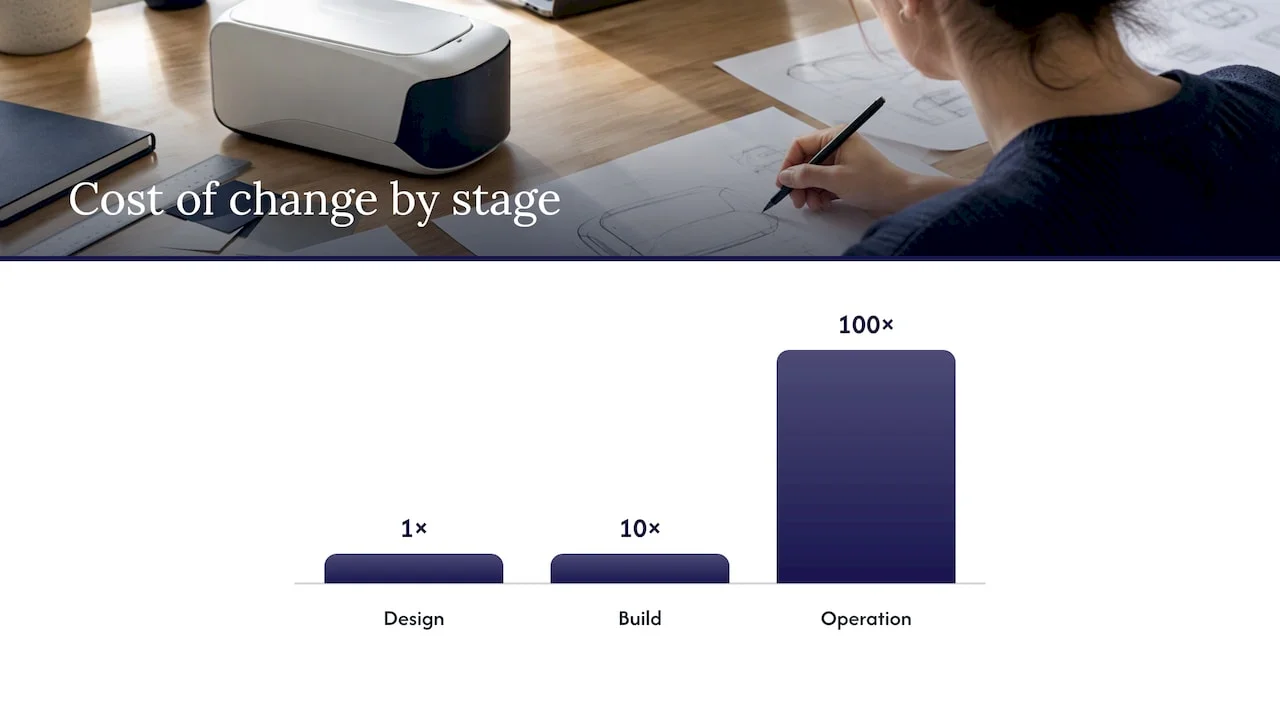
The Institution of Mechanical Engineers makes a point that surprises many people: maintenance does not improve reliability, it preserves the reliability that was designed in. The same guide describes the 1:10:100 rule, where the cost of change rises roughly tenfold at each stage from design to build to operation.
That is why retrofitting reliability through maintenance is expensive. It is also why the best maintenance conversations start before the asset is bought, or before the website is built.
Human skill still counts too. IMechE’s reporting on unmanned dark factories says that without people, engineering has to compensate with more reliability, redundancy, diagnostics and cybersecurity. Automation changes where the skill sits. It does not remove the need for it.
Applying the four types to WordPress client sites
A client website is not a turbine, and nobody is at risk of injury when a contact form breaks. But the economics are the same: unplanned failure is expensive, blanket schedules waste effort, and risk should decide the plan. Here is how the four types look across an agency’s WordPress portfolio.
Corrective: the Sunday evening call
This is the default state for many agencies. A plugin update breaks checkout, a site goes down, the client rings the account manager, and a developer drops billable work to fix it. The hours are often absorbed because nobody agreed a rate for them.
Corrective work will always exist. The problem is when it is the only mode. If you do not charge for it, or cannot respond quickly, it quietly eats margin and goodwill. Our emergency and quick-fix services exist to take that work off your team.
Preventive: scheduled updates and checks
Core, plugin and theme updates, backup verification, uptime checks and security hardening on a calendar. It is predictable and easy to put in a contract. It is also where over-maintenance can creep in: blindly applying every update to every site on the same day, without staging or testing, is the WordPress equivalent of stripping down a healthy motor.
It helps to know what you can bill for. Our list of site management checks agencies can bill for is a practical starting point, and backup cadence is covered in our piece on how often to back up WordPress.
Predictive: monitoring that tells you before the client does
Uptime and performance monitoring, malware scanning, and alerts on failed backups or vulnerable plugins let you act on evidence. This is the closest WordPress equivalent to vibration or temperature monitoring. Our guide to WordPress malware entry points shows the kind of signals worth watching, and our security updates and enhancements service puts that monitoring in specialist hands.
RCM: a risk-based plan per client
A five-page brochure site and a WooCommerce store taking orders all day do not need the same regime. Ask the RCM questions for each: what must this site keep doing, what happens if it fails, and how fast must it come back? The answers set backup frequency, update testing, hosting spec and response times.
This is also where the “intelligent customer” idea helps. You keep the client relationship and set the expectations, while a specialist behind you handles delivery.
| Industrial type | WordPress equivalent | Typical agency example |
|---|---|---|
| Corrective | Emergency fixes | Site down after a failed update |
| Preventive | Scheduled updates and backups | Monthly update and test cycle |
| Predictive | Monitoring and alerts | Uptime, malware and vulnerability alerts |
| RCM | Tiered care by client risk | Different SLA level for shop vs brochure site |
Where the revenue is hiding
Most agencies we talk to are doing all four types of work for clients already, just without a clear scope or price. Corrective hours are absorbed, preventive tasks happen when someone remembers, and nothing is monitored.
That unscoped effort is revenue you are not capturing. The quickest way to see the size of it is our free WordPress Profit Calculator. It takes under 90 seconds, and it turns a vague feeling about lost hours into a figure you can act on.
Perspective: why we think in tiers, not tickets
We have spent years sitting behind agencies, and the pattern is consistent. The agencies that struggle are not careless. They are running corrective maintenance because they never had time to design anything else, and the client has never been asked to choose a level of care.
The engineering lesson we find most useful is the one the research keeps repeating: one schedule for everything wastes effort and leaves gaps. So we prefer a tiered approach. Our published service level agreements give a clear, priced structure that agencies can put in front of clients, rather than inventing terms site by site.
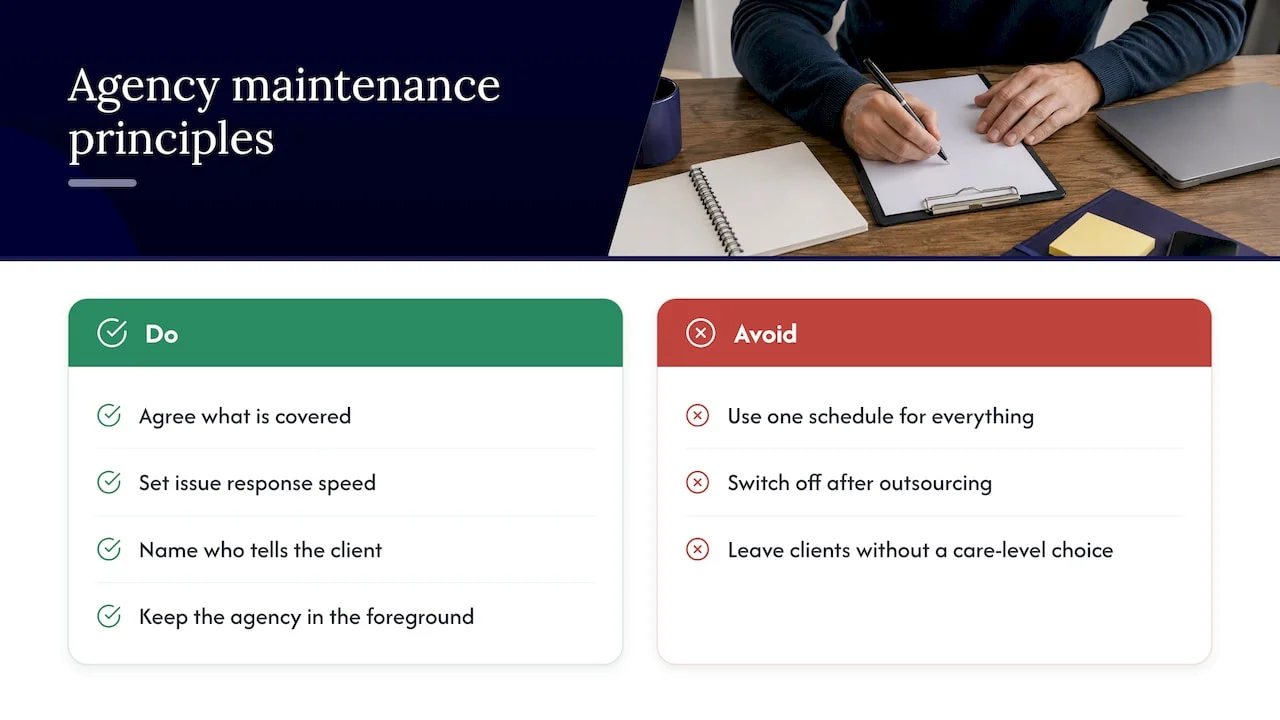
We also believe the agency should stay in the foreground. You own the relationship, the brand and the creative direction. We handle the WordPress work invisibly, so the Sunday evening call goes to us and the client simply sees a site that stays up.
One caution from the HSE’s “intelligent customer” idea: outsourcing does not mean switching off. Agree what is covered, how fast issues get a response and who tells the client. Clear scope is what makes the arrangement work.
— Marcel
Choosing a maintenance mix for your client base
A simple process works for most agencies:
- List your live WordPress sites and note which ones carry revenue, such as shops, booking systems and lead-generation sites.
- Rate each by consequence of failure: low (brochure), medium (lead generation), high (transactions, regulated data).
- Assign a care level. Low-risk sites get scheduled preventive care. High-risk sites get preventive care plus monitoring and faster response.
- Put it in writing, with response times and what is billable outside the plan.
- Review yearly. Sites change, plugins change and risks move.
If you want a ready-made structure, our SLAs are priced per year: Bronze at £450, Silver at £750 and Gold at £1,850. See the full SLA terms and tiers for what each level covers. For work outside a plan, you can buy time as you need it, and our hosting and migration service covers moves and re-hosting.
Work with us behind your agency
If WordPress support is pulling your team away from the creative and strategic work you were hired for, we can take it on under your brand. We handle maintenance, security monitoring, performance, plugin and theme management, hosting, migrations, emergency support and fractional CTO consulting. You keep the client and earn recurring revenue from it.
Start by running the numbers in our Profit Calculator, then talk to us about a partnership.
FAQ
What are the main types of industrial maintenance?
The main types are corrective, preventive and predictive maintenance. Many sources add run-to-failure as a deliberate form of corrective work and reliability-centred maintenance as a framework for choosing between them. Most sites use a blend.
Which type of maintenance is best?
None is best everywhere. Predictive maintenance suits critical, high-value assets, preventive suits parts with known wear patterns, and corrective is acceptable for cheap, non-critical items. Reliability-centred thinking helps you decide by looking at function and consequence of failure.
Is maintenance a legal requirement in the UK?
For work equipment, yes. PUWER 1998 requires employers to keep equipment maintained in a safe condition and, where it is exposed to deterioration, to inspect it at suitable intervals. For your own equipment, check the HSE guidance or speak to a competent engineer or health and safety adviser.
How do these maintenance types apply to a WordPress website?
The logic carries over. Emergency fixes are corrective, scheduled updates and backups are preventive, monitoring and alerts are predictive, and choosing a care level per client by risk is the RCM approach. There is no safety regulation for websites, but the cost of downtime is real.
How can an agency start charging for WordPress maintenance?
Begin by measuring the unbilled support you already deliver. Our Profit Calculator gives you a figure in under 90 seconds. Then package care into clear tiers with defined response times.
Sources
- HSE: Maintenance of work equipment
- HSE: PUWER 1998
- HSE: PUWER 1998 overview
- HSE: Operational guidance on maintenance management
- HSE: Keeping electrical switchgear safe, HSG230
- IMechE: Guide on achieving reliability through the design process
- IMechE: Inside the rise of unmanned dark factories
- Brunel University: Equipment safety and reliability through maintenance engineering
- Siemens: Horizontal ODP/WPI/WPII motor instruction manual