

Running a design or digital agency means juggling creative briefs, client pitches, and strategic campaigns. Yet many UK agencies find themselves pulled into the technical weeds of WordPress maintenance, security patches, and emergency plugin updates. This guide shows you exactly how to outsource WordPress management to white-label providers, freeing your team to focus on the creative work that actually drives revenue and client satisfaction.
Table of Contents
- Key takeaways
- What you need before outsourcing WordPress management
- Step-by-step guide to selecting and working with a white-label provider
- Common challenges and how to avoid them when outsourcing WordPress maintenance
- Expected benefits and outcomes from outsourcing WordPress management
- Explore professional WordPress maintenance services tailored for agencies
- Frequently asked questions
Key Takeaways
| Point | Details |
|---|---|
| Creative capacity freed | Outsourcing WordPress management frees your team to focus on creative work while maintaining client relationships. |
| Round the clock monitoring | The right partner provides round the clock monitoring, security scans and updates invisibly under your brand. |
| Staging is essential | Common pitfalls include skipping staging environments and using untrusted plugins. |
| Hybrid approach preferred | A hybrid approach blending in house creative with outsourced technical support typically delivers the best results. |
What you need before outsourcing WordPress management
Before you contact any white-label provider, you need a clear picture of why you’re outsourcing and what success looks like. Start by defining your agency’s specific objectives. Are you drowning in Sunday evening emergency calls? Losing billable hours to absorbed support work? Struggling to scale WordPress services without hiring developers? Write down the top three pain points you want outsourcing to solve.
Next, audit your current WordPress workload. List every client site you manage, noting which ones consume the most support time. Track how many hours per month your team spends on plugin updates, security patches, backup checks, and performance fixes. This baseline data helps you calculate the true cost of self-managing WordPress and measure the return on outsourcing.
Your technical requirements matter enormously. Any serious white label WordPress support provider must offer automated daily backups with tested restore procedures, staging environments for update testing, real-time security monitoring, and performance optimisation. If a provider can’t demonstrate these capabilities clearly, keep looking.
Pro Tip: Create a simple spreadsheet listing all client sites with their hosting provider, WordPress version, number of plugins, and monthly support hours. This document becomes your briefing pack for potential white-label partners and helps them quote accurately.
Pricing structures vary widely. Some providers charge per site with tiered plans based on complexity, whilst others offer agency bundles. Budget for provider costs plus your markup. Most UK agencies apply a 20-30% markup on white-label services to create profitable recurring revenue. A white label WordPress management guide can walk you through typical pricing models and markup strategies.
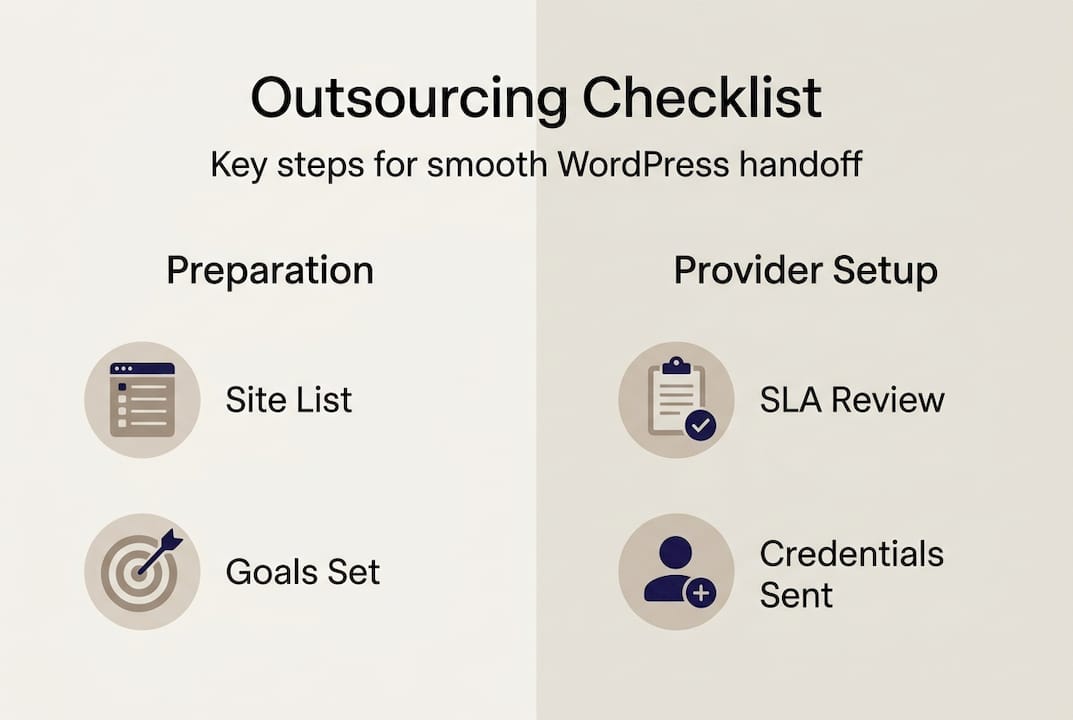
| Preparation checklist | Why it matters |
|---|---|
| Define outsourcing objectives | Ensures provider alignment with agency goals |
| Audit current WordPress workload | Establishes baseline for measuring ROI |
| Document technical requirements | Prevents capability gaps and service failures |
| List all client sites needing management | Enables accurate quoting and onboarding |
| Calculate budget including markup | Ensures profitable service delivery |
Finally, prepare your team for the transition. Explain how outsourcing WordPress maintenance lets them focus on creative work where they add the most value. Address concerns about losing technical control by emphasising that you’ll maintain oversight through white-label reporting and regular provider reviews.
Step-by-step guide to selecting and working with a white-label provider
Choosing the right white-label WordPress management partner determines whether outsourcing becomes a strategic advantage or a costly mistake. Start by researching at least three providers who specialise in agency partnerships. Look for case studies showing they understand agency workflows and client relationship dynamics.
Verify their technical capabilities in detail. Any provider worth considering should offer 24/7 monitoring, automatic backups, plugin and theme updates, security scans, and performance optimisation. Ask specifically about their staging process. How do they test updates before pushing to live sites? What’s their rollback procedure if something breaks? Providers who skip staging cause most update failures, so this question separates professionals from amateurs.
- Request detailed service documentation including SLAs, response times, and escalation procedures
- Review their white-label reporting samples to ensure they match your agency branding
- Check their ticket handling process and confirm all client communication appears under your brand
- Ask about their security protocols, backup retention, and disaster recovery procedures
- Verify they carry professional indemnity insurance covering WordPress management services
- Test their support responsiveness by asking technical questions during the sales process
Establish clear service level agreements covering response times, update schedules, and communication protocols. Your clients expect prompt responses, so the provider’s ticket handling must feel seamless. Insist on white-label reporting that presents all WordPress maintenance and support activity under your agency brand, preserving your client relationships.
Pro Tip: Before committing to a long-term contract, test the provider with one or two smaller client sites for 90 days. This trial period reveals how they handle real-world scenarios and whether their service quality matches their sales promises.
Integration matters as much as capability. Ask how they’ll access client sites securely, whether they support your preferred hosting platforms, and how they handle emergency situations outside business hours. The best providers become invisible extensions of your team, handling technical WordPress delivery whilst you maintain the creative client relationship.
Compare pricing structures carefully. Some providers charge per site with volume discounts, whilst others offer unlimited site management for a fixed monthly fee. Factor in your markup when evaluating costs. A slightly more expensive provider who delivers exceptional service often proves more profitable than a cheap option that generates client complaints. Review self-managing WordPress comparison data to understand the true cost difference between in-house and outsourced management.
Once you’ve selected a provider, create a structured onboarding process. Provide site access credentials securely, brief them on each client’s specific requirements, and establish regular review meetings to discuss performance and any issues. The first 30 days reveal whether the partnership will work long-term, so monitor closely and address any concerns immediately.

Common challenges and how to avoid them when outsourcing WordPress maintenance
Even with careful provider selection, outsourcing WordPress management presents potential pitfalls. Understanding these challenges helps you avoid costly mistakes and maintain service quality.
Security breaches represent the most serious risk. Without proper scanning and backup procedures, a single compromised site can damage your agency’s reputation and client relationships. Insist your provider implements daily security scans, maintains isolated backup storage, and follows WordPress security best practices. Never work with providers who can’t demonstrate robust security protocols.
- Update failures from skipping staging environments cause 70% of WordPress maintenance problems
- Nulled or pirated plugins introduce malware and security vulnerabilities that compromise entire client portfolios
- Performance degradation from plugin bloat requires regular audits of installed extensions
- Poor communication between provider and agency creates client confusion and erodes trust
- Inadequate backup testing means disaster recovery plans fail when you actually need them
Staging environments aren’t optional luxuries. They’re essential safeguards that catch conflicts before they break live sites. Any provider who pushes updates directly to production without testing is gambling with your client relationships. Establish a clear policy requiring staging tests for all plugin, theme, and core WordPress updates. This single practice prevents most emergency situations.
“The difference between professional WordPress management and amateur hour comes down to process discipline. Staging, testing, and rollback procedures separate providers who protect your agency reputation from those who create weekend emergencies.” — Senior WordPress developer with 12 years agency experience
Plugin quality control matters enormously. Avoid nulled or untrusted plugins entirely. The money you save on licensing fees gets wiped out by the first security breach or malware infection. Insist your provider only installs plugins from reputable sources with active development and security track records.
Website performance requires ongoing attention. Monitor core web vitals regularly and audit installed plugins quarterly. Many WordPress sites accumulate unnecessary extensions over time, creating bloat that slows page loads and frustrates visitors. Your provider should proactively recommend removing unused plugins and optimising site performance. Following WordPress update best practices keeps sites secure whilst maintaining speed.
Finally, establish regular provider review meetings. Monthly or quarterly check-ins let you assess service quality, review client feedback, and address any emerging issues before they become serious problems. These sessions also provide opportunities to discuss new services or improvements that benefit your entire client portfolio.
Expected benefits and outcomes from outsourcing WordPress management
Successful WordPress outsourcing delivers measurable improvements across multiple dimensions of your agency operations. Understanding these benefits helps you set realistic expectations and track return on investment.
The most immediate benefit is reclaimed creative capacity. When your designers and strategists stop firefighting WordPress emergencies, they can focus on billable creative work that showcases your agency’s core expertise. Agencies gain scalable capacity and avoid update fires whilst focusing on billable creative hours, often recovering 15-25 hours per month that previously disappeared into absorbed support work.
| Outcome | Before outsourcing | After outsourcing |
|---|---|---|
| Monthly WordPress support hours | 20-30 hours absorbed | 2-3 hours oversight |
| Emergency weekend calls | 2-4 per month | Rare or eliminated |
| Ability to take new WordPress clients | Limited by team capacity | Scalable without hiring |
| Client confidence in technical delivery | Variable based on internal workload | Consistently professional |
| Recurring revenue from WordPress services | Often undercharged or free | Profitable monthly income |
Risk reduction provides enormous value even though it’s harder to quantify. Professional WordPress management catches security threats, update conflicts, and performance issues before they impact client sites. This proactive monitoring prevents the reputation damage and client churn that follow major technical failures.
Scalability transforms your WordPress service delivery. Without outsourcing, growing your WordPress client base means hiring technical staff, which adds overhead and management complexity. With the right white-label partner, you can take on new WordPress clients knowing the technical delivery is handled professionally without expanding your team.
- Greater focus on strategic creative projects that differentiate your agency
- Reduced time spent on technical emergencies and absorbed support hours
- Ability to scale WordPress services without hiring developers or technical staff
- Improved client confidence through consistent professional maintenance
- Financial benefits via managed recurring revenue models with healthy margins
Client satisfaction often improves noticeably. When WordPress maintenance happens reliably in the background, clients experience fewer disruptions and faster response times to technical issues. They see your agency as more professional and capable, even though the actual work happens invisibly through your white-label partner.
Financial benefits extend beyond reclaimed billable hours. Many agencies discover significant uncaptured revenue in their existing WordPress client base. A quick assessment using the WordPress profit calculator often reveals thousands of pounds in potential monthly recurring revenue from clients who currently receive free or undercharged WordPress support. Converting these relationships to properly priced maintenance agreements creates predictable income that improves agency cash flow and valuation.
Real-world results demonstrate these benefits clearly. One UK design agency reduced WordPress support time by 85% within 60 days of outsourcing, allowing their creative team to take on three additional branding projects that quarter. Another agency converted 12 clients receiving free WordPress updates to paid maintenance agreements, generating an additional £8,400 in monthly recurring revenue. These outcomes aren’t exceptional. They’re typical results when agencies partner with capable white-label providers and properly price their services. Review the design agency WordPress case study for detailed examples of outsourcing success.
Explore professional WordPress maintenance services tailored for agencies
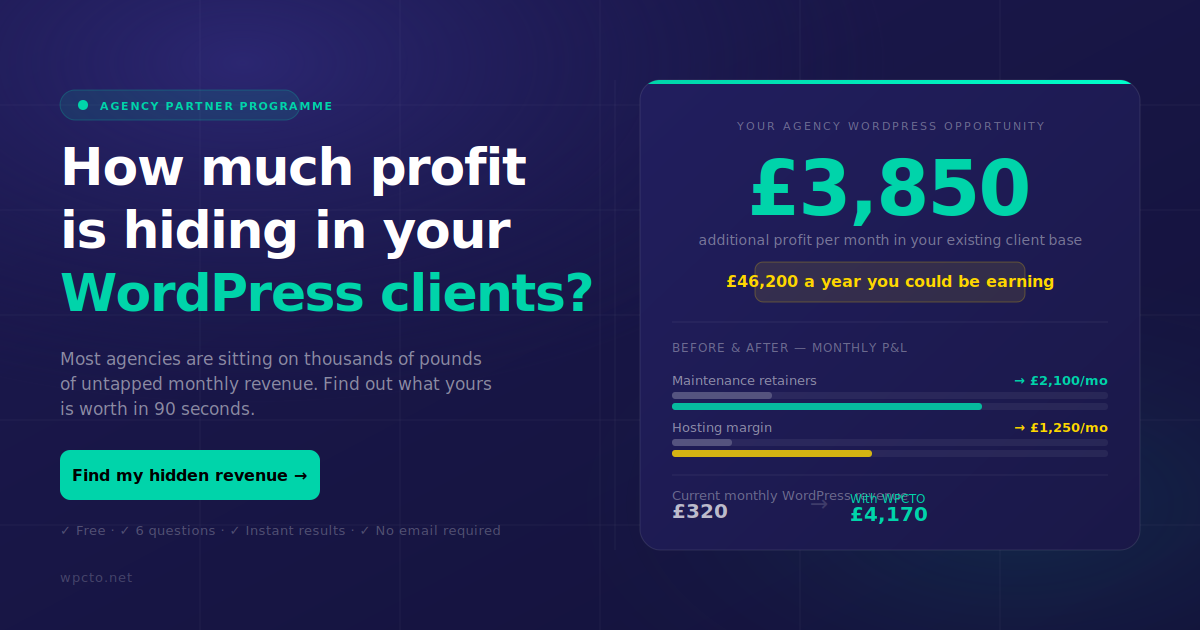
If the challenges and benefits described in this guide resonate with your agency experience, you’re not alone. Most UK design and digital agencies reach a point where managing WordPress in-house stops making strategic sense. WPCTO specialises in white-label WordPress management built specifically for agencies like yours. We handle the technical delivery invisibly under your brand whilst you maintain client relationships and focus on creative work.
Our WordPress maintenance and support services include 24/7 monitoring, security scanning, performance optimisation, and staging-tested updates. Everything appears under your agency brand through white-label reporting, so your clients never know we exist. We become your invisible technical team, handling WordPress delivery whilst you concentrate on the creative and strategic work that differentiates your agency. Explore our white label WordPress support services to see how we help agencies scale WordPress delivery without hiring technical staff, or use the WordPress profit calculator for agencies to discover uncaptured revenue in your current client base.
Frequently asked questions
Is outsourcing WordPress management costly for small agencies?
White-label WordPress maintenance plans start at £47-100 per site monthly, with exact pricing depending on site complexity and service scope. Most UK agencies apply a 20-30% markup when reselling these services to clients, creating profitable recurring revenue that covers provider costs and generates margin. The key financial question isn’t whether outsourcing costs money, but whether it costs less than the absorbed hours and opportunity cost of managing WordPress in-house.
Can agencies maintain brand control when using white-label providers?
Yes, maintaining complete brand control is the entire point of white-label services. Providers handle tickets invisibly under your agency brand with white-label reporting that presents all maintenance activity as if your team performed the work. Your clients interact exclusively with your agency, never knowing a third party handles the technical delivery. This arrangement preserves your client relationships whilst giving you access to specialist WordPress expertise.
What common mistakes should agencies avoid during outsourcing?
The most damaging mistake is working with providers who skip staging environments before pushing updates. Skipping staging causes most update failures and risks breaking live client sites. Never compromise on this requirement. Similarly, avoid any provider who uses nulled plugins, as these introduce serious security vulnerabilities. Always insist on proper staging tests, security scanning, and backup verification before committing to a white-label partnership.
How long does it take to transition WordPress management to a white-label provider?
Most agencies complete the transition in 30-60 days depending on portfolio size. The process involves providing secure site access, briefing the provider on client-specific requirements, and monitoring service delivery during the initial period. Start with one or two smaller client sites as a trial, then roll out to your full portfolio once you’ve verified the provider’s service quality and communication processes meet your standards.
Will clients notice when we outsource WordPress management?
Not if you choose the right white-label partner. Professional providers operate invisibly, handling all technical work behind the scenes whilst maintaining your agency branding in all client communications. Many agencies report that clients actually notice improved service quality and faster response times after outsourcing, though they attribute these improvements to the agency rather than recognising the white-label arrangement. The key is selecting a provider who understands agency dynamics and commits to seamless white-label delivery.