

Managing graphic design websites can drain your agency’s time and budget faster than almost any other operational task. Between plugin updates, security patches, and client support requests, your team spends hours each week on website maintenance instead of creative work. Finding the right platform is crucial to freeing your focus on what you actually do best. This article guides you through the essential criteria and top platform options to simplify website management, reduce costs, and help your agency reclaim billable hours.
Table of Contents
- Key takeaways
- Selecting the right platform: key criteria for graphic design agencies
- Top platforms for graphic design websites: WordPress, Webflow, and no-code builders
- Comparing platform costs and management effort for agencies
- When to choose managed WordPress hosting over no-code platforms
- Discover expert WordPress maintenance and support tailored for agencies
- Frequently asked questions
Key Takeaways
| Point | Details |
|---|---|
| No code platforms reduce maintenance | No code platforms dramatically cut ongoing maintenance time compared with WordPress, freeing more hours for creative work. |
| Webflow balance design CMS | Webflow combines strong design control with a built in CMS, reducing the need for plugins and simplifying ongoing maintenance. |
| Vendor lock in | Format Squarespace and Wix offer fast setup and simplicity but carry vendor lock in considerations that can restrict future flexibility. |
| Managed WordPress cost predictability | Managed WordPress hosting shifts updates security and backups to the provider while keeping WordPress flexibility and reducing admin overhead. |
Selecting the right platform: key criteria for graphic design agencies
Before diving into specific platform options, you need a clear framework for evaluation. The wrong choice can lock your agency into years of unnecessary maintenance work or limit your ability to deliver the creative solutions your clients expect.
Start with total cost of ownership. This includes build costs, monthly or annual hosting fees, maintenance time, and any specialist support you’ll need. A platform that looks cheap upfront can become expensive when you factor in the hours your team spends managing it.
Time and complexity of ongoing management matters enormously. How many hours per month will your team spend on updates, backups, and troubleshooting? Can non-technical staff handle basic changes, or does every edit require developer time?
Design flexibility is non-negotiable for creative agencies. You need platforms that let you deliver the visual quality and unique layouts your clients expect without fighting against templates or limitations.
CMS capabilities determine whether clients can update their own content confidently. The easier it is for clients to make simple changes themselves, the fewer support requests land on your desk.
SEO and site performance directly affect your clients’ business results. Platforms that generate bloated code or slow page loads will reflect poorly on your agency’s expertise.
Security and plugin dependency create ongoing risk. The more plugins a platform requires for basic functionality, the more potential security vulnerabilities and compatibility issues you’ll face.
Top platforms for graphic design websites: WordPress, Webflow, and no-code builders
WordPress remains the most flexible option for complex, custom websites. You can build virtually anything with the right combination of themes, plugins, and custom code. However, this flexibility comes at a significant cost in maintenance time. UK creative agencies report 94% reduction in plugin update time and over £1,000 saved annually by migrating from self-managed WordPress to managed hosting or Webflow. Plugin conflicts, security patches, and compatibility issues can consume dozens of hours monthly.
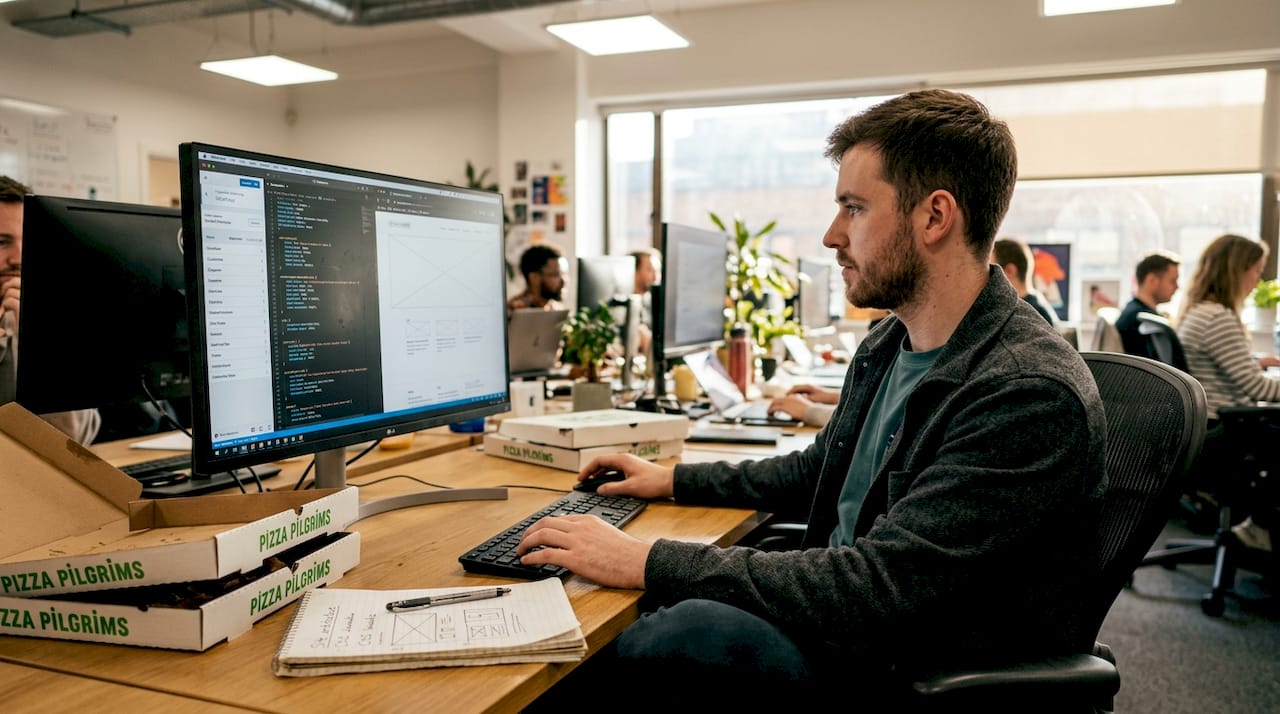
Webflow eliminates the plugin ecosystem entirely by building core functionality directly into the platform. You get visual design control comparable to WordPress page builders, but without the security patches and update cycles. The CMS allows clients to edit content inline without touching code or navigating complex admin panels. For agencies needing both design control and simpler ongoing management, Webflow achieves an excellent balance.
No-code platforms like Format, Squarespace and Wix prioritise simplicity and speed. Format specialises in portfolio sites for creatives with beautiful templates and integrated client proofing. Squarespace offers strong e-commerce capabilities alongside elegant design templates. Wix provides the most extensive drag-and-drop functionality with a massive template library. All three dramatically reduce build time and eliminate technical maintenance, though they offer less design flexibility than WordPress or Webflow.
Managed WordPress hosting presents a middle path. Services like those offered through managed WordPress hosting benefits handle all updates, security monitoring, backups, and performance optimisation. Your agency retains full WordPress flexibility whilst offloading the maintenance burden. This works especially well for agencies with existing WordPress sites who want to reduce management overhead without rebuilding.
Pro Tip: Use the WordPress profit calculator for agencies to quantify exactly how much time and revenue your current WordPress management approach is costing. Most agencies discover thousands of pounds in uncaptured value sitting in their existing client base.
Comparing platform costs and management effort for agencies
Understanding the true cost of each platform requires looking beyond monthly subscription fees. WordPress agency sites cost from £5,000 to £15,000 to build plus £500 to £1,500 yearly maintenance, whilst Webflow and no-code cost around £9 to £35 per month all-in.
| Platform | Build Cost | Monthly Cost | Management Hours/Month | Best For |
|---|---|---|---|---|
| WordPress (self-managed) | £5,000-£15,000 | £15-£50 hosting | 20-40 hours | Complex custom sites |
| WordPress (managed) | £5,000-£15,000 | £200-£500 | 2-5 hours | Agencies wanting flexibility without maintenance |
| Webflow | £3,000-£8,000 | £12-£35 | 1-3 hours | Design-focused agencies needing CMS |
| Squarespace | £1,000-£3,000 | £11-£33 | 0-2 hours | Simple business sites with e-commerce |
| Format | £800-£2,500 | £8-£20 | 0-1 hours | Creative portfolios |
| Wix | £800-£2,500 | £10-£27 | 0-2 hours | Small business sites |
Time investment tells the real story. Self-managed WordPress sites can consume 20 to 40 hours monthly across plugin updates, security monitoring, backup verification, and troubleshooting. Managed WordPress reduces this to 2 to 5 hours. Webflow typically requires 1 to 3 hours for content updates and minor design tweaks. No-code platforms need virtually zero technical maintenance.
To calculate your agency’s ideal platform choice:
- List all current websites you manage and estimate monthly maintenance hours for each.
- Multiply total hours by your internal hourly rate to find your true maintenance cost.
- Compare this against managed hosting fees or platform subscription costs.
- Factor in opportunity cost: what billable work could your team do with reclaimed time?
- Consider client satisfaction: fewer emergency calls and faster turnaround improve retention.
- Evaluate migration complexity: moving existing sites requires upfront investment but often pays back within months.
Most agencies discover that platforms requiring less technical management actually cost less overall, even when monthly fees are higher. The WordPress profit calculator automates this analysis, showing you the financial impact of different platform choices in under 90 seconds. A managed WordPress case study demonstrates how one agency reclaimed 35 hours monthly whilst improving client service quality.
When to choose managed WordPress hosting over no-code platforms
Managed WordPress hosting makes most sense when your agency needs advanced custom functionality that no-code platforms cannot deliver. Complex membership systems, custom API integrations, or highly specific design requirements often demand WordPress’s flexibility.
It’s also ideal for agencies wanting to offload WordPress complexity whilst preserving complete design control. You maintain the ability to build anything whilst eliminating the operational burden of updates, backups, and security monitoring. Managed WordPress hosting offers 100% predictable costs and significant time savings, reducing plugin updates from 80 to 5 hours a month for agencies.
Agencies with substantial existing WordPress client bases benefit enormously from managed hosting. Migrating dozens of client sites to new platforms creates massive project overhead. Managed hosting lets you improve service quality and reduce internal costs without rebuilding everything.
White label WordPress support adds another dimension. You can resell professional WordPress maintenance under your own brand, turning a cost centre into a profit centre. Your clients get expert support, you earn recurring revenue, and your team never touches a support ticket.
Pro Tip: Managed hosting works brilliantly for agencies with 10 or more WordPress client sites. Below that threshold, migrating to Webflow or no-code platforms often makes more financial sense. Above it, the economics of managed hosting become compelling.
Choose no-code platforms when design requirements are straightforward and clients need maximum editing simplicity. A boutique consultancy wanting an elegant brochure site doesn’t need WordPress’s complexity. Format suits creative portfolios perfectly. Squarespace excels for small e-commerce. Wix handles general business sites efficiently.
The decision ultimately comes down to your agency’s positioning. Are you selling complex technical solutions requiring custom development? Managed WordPress preserves that capability. Are you focused on brand, design, and strategy with websites as a supporting service? No-code platforms let you deliver quality sites without becoming a technical support desk.
Managed WordPress dramatically cuts admin time and unexpected costs whilst preserving the flexibility our agency needs for complex client projects.
Discover expert WordPress maintenance and support tailored for agencies
If you’re still managing WordPress sites in-house, you’re probably spending more time and money than necessary whilst limiting your agency’s growth potential. WPCTO specialises in offloading WordPress maintenance for UK creative and digital agencies, handling everything from hosting and updates to security monitoring and emergency support.
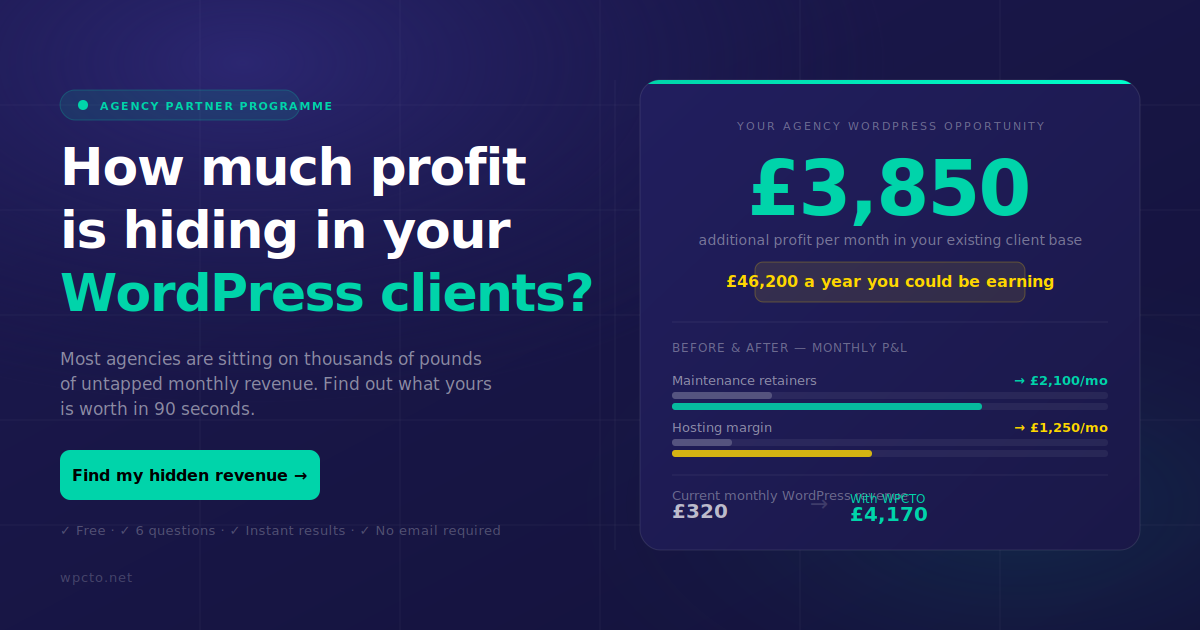
Our seamless WordPress maintenance for agencies includes expert hosting, proactive updates, comprehensive security, and performance optimisation. We work invisibly behind your agency through white label WordPress support, so you retain client relationships and brand control whilst we handle all technical delivery. Your clients get superior service, you earn recurring revenue, and your team never touches another plugin update.
Use the WordPress profit calculator right now to see exactly how much uncaptured revenue sits in your existing WordPress client base. Most agencies discover they can save thousands of pounds annually whilst improving service quality and reclaiming dozens of billable hours each month.
Frequently asked questions
How much can my agency save by switching to managed WordPress or no-code?
Most agencies save between £8,000 and £25,000 annually by moving from self-managed WordPress to managed hosting or no-code platforms. This includes reduced internal labour costs, fewer emergency support hours, and eliminated plugin licensing fees. The exact savings depend on how many sites you manage and your current internal hourly rates.
Will migrating away from WordPress hurt my clients’ SEO rankings?
Not if you handle redirects properly and maintain content quality. Webflow and quality managed WordPress hosting often improve performance metrics like page speed, which positively affects SEO. The key is implementing 301 redirects for all URLs and preserving existing content structure during migration.
Can clients still edit content easily on Webflow or managed WordPress?
Yes, often more easily than standard WordPress. Webflow’s inline CMS editing lets clients change text, images, and content blocks directly on the page without navigating complex admin panels. Managed WordPress can include simplified admin interfaces that hide technical complexity from clients.
What happens if I want to leave a no-code platform later?
Migration difficulty varies by platform. Webflow allows HTML/CSS export, though you’ll need to rebuild CMS functionality elsewhere. Squarespace and Wix offer content export but not design templates, meaning you’ll essentially rebuild sites from scratch. This vendor lock-in is the main trade-off for simplified management.
How complex is migrating existing WordPress sites to managed hosting?
Fairly straightforward with the right partner. Managed WordPress services typically handle the entire migration process, including content transfer, plugin configuration, and testing. Most sites migrate within 24 to 48 hours with zero downtime. The complexity increases with custom plugins or unusual hosting configurations, but experienced providers manage these smoothly.
Does managed WordPress hosting support white label arrangements?
Yes, most quality managed WordPress providers offer white label partnerships specifically for agencies. You maintain all client communication and branding whilst the provider handles technical delivery invisibly. This lets you offer premium WordPress maintenance under your own brand without hiring specialist staff.