

Agencies managing roughly 10 to 30 WordPress sites for local-business clients should choose a retainer model with a white-label partner; agencies beyond that scale, or those carrying complex WooCommerce portfolios, need an embedded developer instead. Ticket-based support only makes sense for occasional, low-stakes fixes. Before committing to either, run your numbers through the WPCTO WordPress Profit Calculator to see what unbilled support hours are actually costing you.
TL;DR:
- Agencies managing fewer than 10 sites may benefit from ticket-based support, but it hampers predictability and turnaround for higher volumes.
- White-label partnerships are ideal for agencies with 10 to 30 sites, providing predictable retainers, concrete reporting, and freeing staff from emergency tasks.
- Moving to embedded developers is suitable for agencies with over 30 sites or complex WooCommerce setups, but requires mature project management and clear SLAs.
- Running unbilled support hours can significantly erode margins; using the WordPress Profit Calculator reveals potential revenue gains from structured retainers.
- Proper onboarding, aligned communication tools, and legal clarity on contracts protect agency interests and ensure smooth, scalable support relationships.
Table of Contents
- Why a white-label WordPress partner protects your client relationships
- Which outsourcing model actually fits your agency?
- How do you choose the right outsourcing model?
- What does a realistic onboarding timeline look like?
- How do you avoid rework without adding management overhead?
- What does outsourcing actually cost compared to hiring?
- How much revenue is sitting uncaptured in your client base right now?
- What tools do agencies need for white-label WordPress management?
- Which communication tools keep client work coordinated?
- How do you brand white-label services as your own?
- What legal terms should white-label maintenance contracts cover?
- Marcel’s view: three mistakes agencies make and how to fix them
- How Wpcto can help you turn maintenance into recurring revenue
- Sources
Why a white-label WordPress partner protects your client relationships
Every agency that builds WordPress sites for local businesses eventually hits the same wall: the client relationship is yours, but the ongoing technical burden pulls your best people away from the creative and strategic work you were hired to do. A white-label partner solves that without you ever handing over the relationship.
A white-label partner typically works behind the scenes on maintenance, security monitoring, performance optimisation, plugin and theme management, migrations, emergency fixes, and fractional CTO support. Typical white-label maintenance plans, as Codelibry notes, include backups, plugin and theme updates, PHP updates, and monthly audits and reports. That reporting layer matters more than agencies expect. It is what lets you upsell clients on the back of concrete evidence, rather than a vague promise that “the site is being looked after.”
The outcomes agencies see:
- Reclaimed billable hours previously lost to Sunday-evening emergency calls
- Predictable retainer income instead of unbilled favours
- A partner who reports and audits in a way that supports upsells, not just fixes
- No plugin-update anxiety sitting on your senior developer’s desk
Pro Tip: Before you sign any partner, ask to see a sample monthly report. If it reads like a task log rather than a client-ready document, it will not help you sell anything upward.
Run your own client list through the profit calculator and you will likely find more uncaptured revenue than you assumed.
Which outsourcing model actually fits your agency?
Three models dominate white-label WordPress outsourcing, and picking the wrong one is usually what causes agencies to sour on outsourcing altogether.
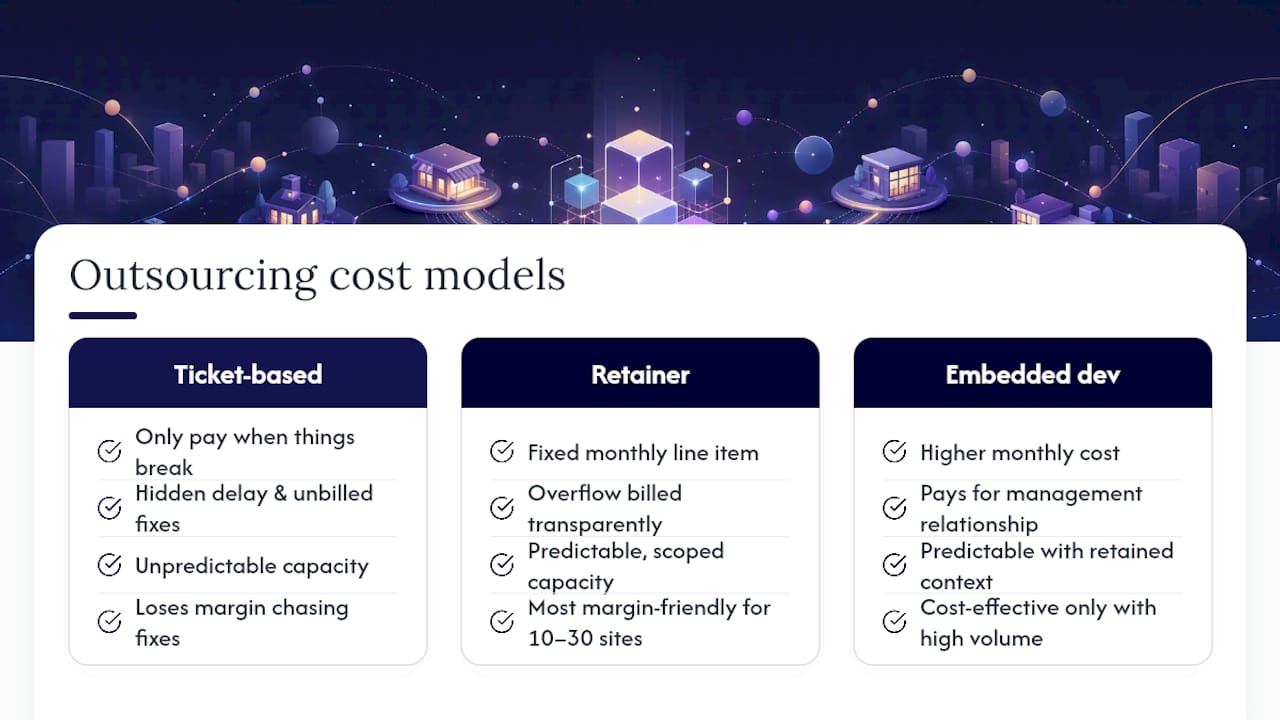
- Ticket-based support. You pay per fix, per issue, with no ongoing commitment. It suits agencies with a handful of low-traffic sites and infrequent problems, but it punishes you on turnaround and gives you zero predictability on cost or capacity.
- Retainer. A fixed monthly fee covers a defined scope of maintenance, monitoring and a set number of support hours. Retainers fit agencies managing roughly 10 to 30 sites, giving you context continuity without the overhead of managing a dedicated hire.
- Embedded developer. A partner-supplied developer works inside your team structure, attending standups and carrying institutional knowledge of your accounts. This suits agencies with 30-plus sites or complex WooCommerce configurations, but only when your internal project management is mature enough to direct that resource properly.
The practical indicators for moving between models are straightforward: site count, the proportion of clients running WooCommerce or booking systems, and how often emergencies actually occur. A jump from three emergency tickets a month to fifteen is a clear signal you have outgrown ticket-based support. A jump past 30 managed sites, with recurring feature requests rather than just fixes, is the signal to consider embedding.
How do you choose the right outsourcing model?
Run this checklist before you commit to any model. It takes fifteen minutes and will save you months of the wrong arrangement.
- Site count. Under 10, ticket-based may be fine. 10 to 30, retainer is the sweet spot. Over 30, consider embedded.
- Revenue dependence. Are any client sites revenue-critical (WooCommerce, bookings, lead generation)? If yes, treat outsourcing as risk mitigation, not just cost control.
- Complexity. Custom plugins, multiple WooCommerce stores, or heavy integrations push you towards retainer or embedded, never ticket-based.
- PM maturity. Do you have someone who can brief, direct and review an embedded developer’s work weekly? If not, an embedded hire will slow you down rather than speed you up.
- Emergency frequency. Track how many “urgent” requests hit your inbox monthly. Above five or six, a retainer with defined SLA response times pays for itself quickly.
- SLA needs. Local-business clients rarely tolerate downtime during trading hours. That alone often justifies moving off ad hoc support.
The clearest red flag for an embedded hire is a sporadic workload paired with no dedicated project manager. Embedded developers improve context retention, but they require a mature PM structure behind them; without it, the added coordination overhead cancels out the benefit.
Quick exercise: add up every unbilled support hour your team logged last month, at your standard hourly rate. Agencies routinely discover this figure eats into margin far more than they realised, because maintenance tasks left unmeasured quietly become unbilled overhead. Multiply that hourly figure by 12 and you have a rough annual number. Then feed your actual client list into the WPCTO WordPress Profit Calculator to see what a retainer partnership could convert into recurring revenue in under 90 seconds.
What does a realistic onboarding timeline look like?
Onboarding should never feel like a leap of faith. A well-run partner gives you a defined path from handover to steady state.
- Discovery audit. The partner reviews every site: plugin versions, hosting environment, backup status, and any known vulnerabilities.
- Access and staging setup. You hand over credentials once, securely, and a staging environment is verified before any live changes happen.
- Priority ticket triage. Existing bugs and requests get sorted by business impact, not just age.
- First fixes. Critical issues get resolved inside the first 30 days, which is when most onboarding failures or successes become visible.
At 30 days, expect stabilised sites and a clear backlog. At 60 days, you should see fewer emergency tickets and the first monthly audit report land in your inbox. By 90 days, the relationship should feel routine rather than reactive, with reporting cadence settled and no surprises.
Your SLA should specify:
- Response times by ticket priority (critical, high, standard)
- A named escalation path when something goes beyond first-line fixes
- Reporting cadence, ideally monthly, with metrics you can show clients
- Exit and migration terms, so you are never locked into a partner who underperforms
How do you avoid rework without adding management overhead?
The temptation with any outsourced partner is to build a parallel management system just to keep tabs on them. Resist it. The better approach is making the partner work inside the systems you already run.
Require the partner to operate inside your existing project management tool rather than their own portal. A partner who reports and audits within your workflow is far easier to hold accountable, and it means your account managers never have to log into a second system to check status.
To cut rework:
- Use brief templates that force every ticket to state business impact, acceptance criteria and deadline
- Run QA against a fixed checklist before anything ships to a client site
- Sample a percentage of closed tickets monthly to catch drift in quality
- Hold a short monthly audit call rather than daily check-ins
Clear QA processes and acceptance criteria materially reduce rework across a mixed portfolio, particularly when different team members are touching the same client’s site over time.
Pro Tip: Track partner performance on three numbers only: average response time, percentage of tickets resolved first-time, and client-reported issues per month. More than three metrics and nobody on your team will actually look at the dashboard.
What does outsourcing actually cost compared to hiring?
Cost comparisons only make sense once you separate the three models properly. Ticket-based support looks cheapest on paper because you only pay for what breaks, but the true cost hides in delay and in the margin you lose chasing unbilled fixes between tickets.
A retainer converts that unpredictability into a fixed monthly line item, usually scoped to a defined number of sites and support hours. This tends to be the most margin-friendly option for agencies in the 10 to 30 site range, because you are paying for capacity you will actually use, and any overflow gets billed transparently rather than absorbed by your own team.
Embedded developers cost more per month than a retainer, but the calculation changes once you account for institutional knowledge. An embedded resource does not need re-briefing on every ticket, which matters when a portfolio includes complex WooCommerce builds where context loss is expensive. The trade-off is that you are effectively paying for a management relationship, not just delivery, so the cost only pays off with steady, high volume work.
The real comparison you need to run is not “which model is cheapest” but “which model stops me losing margin on work I am not charging for.” That is precisely what the profit calculator is built to surface, and it takes far less time than building your own spreadsheet from scratch.
How much revenue is sitting uncaptured in your client base right now?
Most agencies underestimate this number, often significantly, because unbilled support work rarely gets logged consistently enough to total up. A developer who spends twenty minutes on a “quick favour” for a client rarely records it anywhere, and that twenty minutes repeated across a dozen clients a month adds up to real hours you are simply giving away.
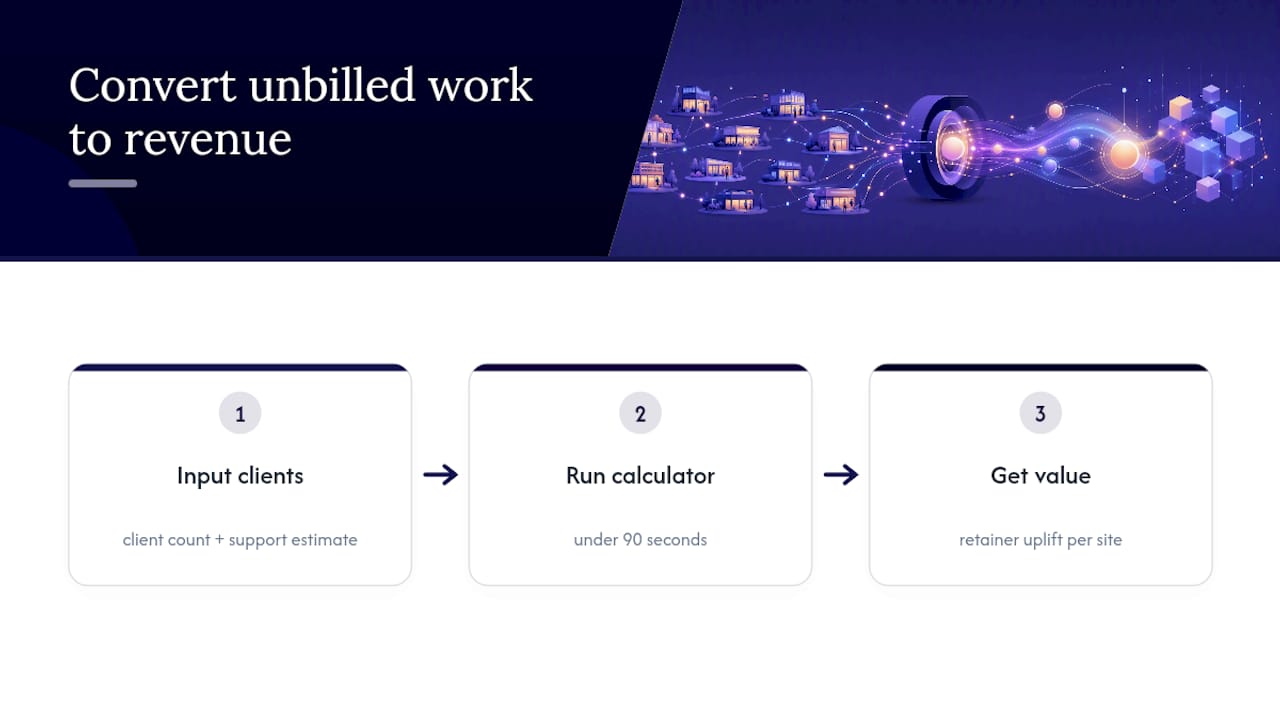
The WPCTO WordPress Profit Calculator exists specifically to close that gap. You input your current client count and a rough estimate of the support work already happening informally, and it shows you, in under 90 seconds, what that time is worth if converted into a structured retainer instead. For an agency with 20 active WordPress clients, even a modest average retainer uplift per site compounds into a meaningful new revenue stream, one that runs alongside your existing project work rather than competing with it.
This is not a theoretical exercise. It is the single fastest way to justify moving from informal, unbilled support to a proper white-label maintenance arrangement, because it gives you a number to take into your next internal planning conversation. Try the calculator against your own client list before you decide which outsourcing model to pursue. The answer often changes the urgency of the decision entirely.
What tools do agencies need for white-label WordPress management?
A retainer or embedded arrangement only works smoothly when the underlying tooling supports it. Look for a partner using a proper management dashboard, something that centralises uptime monitoring, backup status and update history across every site in your portfolio, rather than checking each site manually.
Automation matters most for the repetitive, low-judgement work: automated plugin and core updates on staging before anything touches production, automated backup verification, and automated uptime alerts that reach the right person within minutes, not hours. Security monitoring tools that flag malware signatures or brute-force login attempts in real time are non-negotiable for client sites handling any customer data or payments.
Reporting tooling deserves particular attention because it is what your account managers will actually show clients. A partner who can generate a clean, branded monthly report covering updates completed, issues resolved and uptime percentage gives your team something tangible to present in a client meeting, turning invisible maintenance work into a visible value story. Ask any prospective partner exactly what reporting format they provide before you sign anything, because a rough activity log is very different from a client-ready document.
Which communication tools keep client work coordinated?
The biggest friction point in any outsourcing arrangement is not the technical work, it is the coordination. Choose a partner willing to work inside the tools you already run rather than forcing you onto theirs.
Shared project management tools such as Asana, Trello or ClickUp work well for tracking tickets end to end, provided the partner actually logs status changes rather than leaving your account manager to chase updates. For faster back-and-forth, a shared Slack channel per client or per portfolio segment keeps urgent questions out of email threads that get missed. Video calls, via Zoom or Google Meet, are worth reserving for monthly audit reviews rather than routine updates, since daily calls quickly become their own time cost.
Documentation matters just as much as live communication. A shared knowledge base, in Notion or Confluence, covering each client’s specific quirks, custom plugins and past incidents prevents the same question being asked twice by two different partner staff. The goal across every tool choice is the same: reduce the number of places your team has to check for status, not add another dashboard nobody opens.
How do you brand white-label services as your own?
Clients should never know Wpcto exists behind your maintenance offer, and that is precisely the point of a white-label arrangement. Reports, emails and support confirmations should carry your agency’s name, logo and tone throughout, with the partner working invisibly in the background.
Beyond basic rebranding, the strongest agencies package their maintenance offer as a distinct product line with its own name and tiered pricing, rather than an afterthought bolted onto a project quote. Naming your care plans (Essential, Growth, Priority, for instance) and defining what sits in each tier gives account managers something concrete to sell, rather than a vague “ongoing support” line item that clients undervalue.
Customising the reporting cadence by client tier also reinforces the brand value: a higher-tier client might get a monthly call alongside their report, while a lower-tier client receives the report alone. That differentiation is what lets you justify a genuine price gap between tiers, and it is far easier to sell an upgrade when the current tier already looks professional and well-presented.
What legal terms should white-label maintenance contracts cover?
Offering white-label maintenance to local-business clients means you are the party contractually responsible for their site, even though a partner is doing the technical work behind you. That makes your contract terms with both the partner and the end client worth getting right from day one.
With your white-label partner, confirm data processing terms clearly, particularly around who can access client hosting credentials and how those are stored. Define liability for downtime or data loss, and make sure the contract specifies a clear exit and migration path so you are never trapped with an underperforming partner holding your clients’ sites hostage.
With your end clients, your own service agreement should state what “maintenance” actually covers, what counts as an emergency versus a billable enhancement, and your standard response times. Local-business clients often assume “maintenance” means unlimited free changes; a clear scope in writing prevents that misunderstanding from becoming a dispute. None of this replaces proper legal advice specific to your jurisdiction and contract type, but any partner worth using should be able to walk you through their standard terms without hesitation.
Marcel’s view: three mistakes agencies make and how to fix them
The agencies that struggle most with outsourcing usually make the same three mistakes. First, they accept ad hoc work indefinitely instead of ever formalising a retainer, so margin quietly leaks away. Second, they underprice support because nobody ever measured what it actually costs to deliver. Third, they skip onboarding rigour, expecting a partner to simply “know” a client’s site without a proper discovery audit.
The fix for all three is the same discipline: measure your unbilled hours honestly, pilot a retainer with your most demanding client rather than your easiest one, and insist on standardised briefs and QA from day one. Agencies that do this stop treating maintenance as a cost centre and start treating it as one of their most predictable revenue lines.
— Marcel
How Wpcto can help you turn maintenance into recurring revenue
A white-label partner is an alternative to hiring internally or juggling ticket-based freelancers for WordPress maintenance. Agencies keep every client relationship and retainer revenue while the partner handles plugin updates, security monitoring, performance work, migrations and fractional CTO advice invisibly behind the agency’s brand.
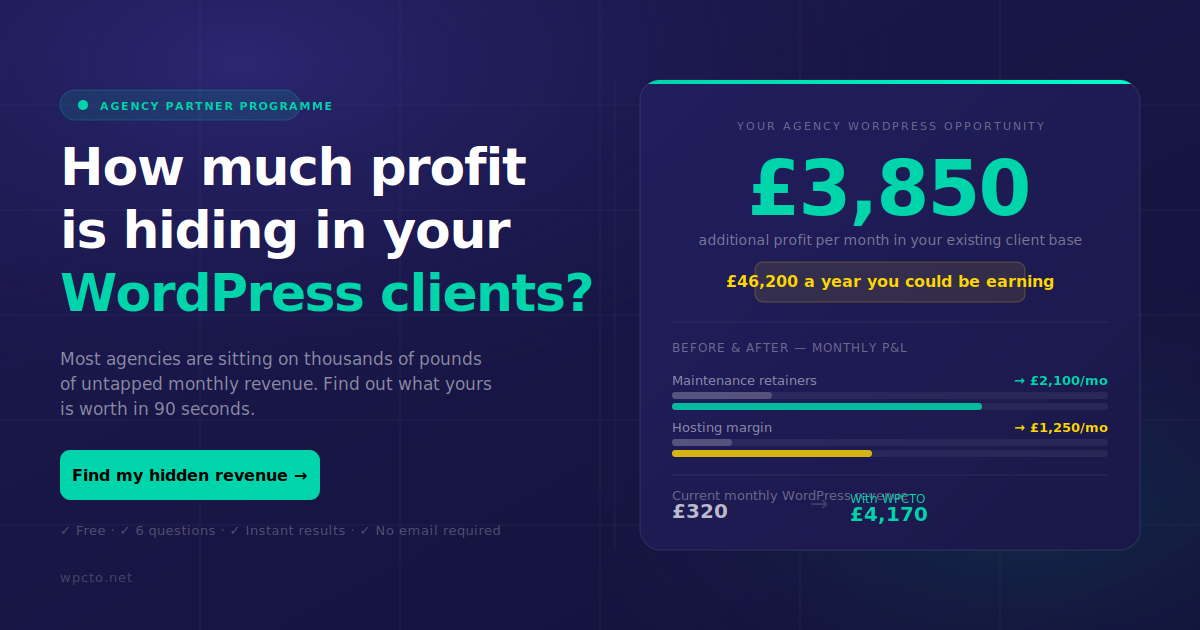
Whether your portfolio sits comfortably in the 10 to 30 site retainer zone or has grown past the point where embedded support makes sense, the starting point is the same: find out what your current client base is actually worth. Run your numbers through the WPCTO WordPress Profit Calculator and see the uncaptured revenue sitting in support work you are not yet charging for.
From there, visit our agency services page to see how our white-label partnership works in practice, or book a discovery call to talk through your specific client mix, SLA needs and onboarding timeline. No obligation, no jargon, just a straight conversation about whether a retainer or embedded arrangement fits your agency right now.
Sources
For deeper detail on service tiers, see WPCTO’s agency services page and white-label support details. For scaling models beyond WordPress maintenance, BabyLoveGrowth’s white-label guide covers broader partnership structures.
- Outsourcing wordpress maintenance vs in-house – Codelibry
- Ticket-Based vs Retainer vs Embedded WordPress Outsourcing
- Outsource WordPress maintenance or do it yourself? | Jorijn Schrijvershof