

When a client’s WordPress site is hacked, hand it straight to a specialist white‑label recovery partner rather than fixing it yourself. Demand three outcomes from day one: containment within the hour, a verified clean restore with a forensic report naming the entry point, and a handback under your own agency branding. Done properly, the incident becomes the trigger for a paid care retainer, not a written‑off support ticket.
TL;DR:
- A white-label recovery partner must provide immediate containment, manual malware removal, and a verified clean restore with a forensic report pinpointing the breach entry point.
- Hardening measures such as credential rotation, plugin governance, and security rules should be included in the initial fee, not billed as extras.
- Recovery involves a testable sequence including triage, backup verification, manual cleanup, staged testing, and final hardening, with most sites restoring within hours.
- Clients should demand SLAs with response times under one hour and ensure the partner uses agency branding, no direct client contact, and follows a written invisibility protocol.
- Turning a hacked site into ongoing security care is an effective way for agencies to generate recurring revenue through structured maintenance and support plans.
Table of Contents
- What must a white‑label recovery partner deliver?
- How does professional recovery actually work?
- How should you compare and onboard a recovery partner?
- Turning a hacked‑site emergency into a retainer
- What agencies get wrong about outsourcing recovery
- Get a recovery partner your clients never see
What must a white‑label recovery partner deliver?
An agency proposal that skips any of the following is not a recovery service worth the risk. It is a patch job with a delayed second breach.
Containment and triage. A serious partner should confirm receipt quickly and have the site contained (isolated, quarantined, taken offline if needed) promptly after the incident is reported. If anything is slower, the malware keeps spreading, indexing on blacklists, or emailing spam through your client’s domain.
Malware removal and restore. Look for manual file and database sanitisation, not just a plugin scan. 3Zero Digital’s white‑label service scope reflects the industry standard here: backdoor sweeps, blacklist recovery, and a properly verified clean backup before anything goes live again.
A named forensic report. Insist on a post‑incident report that identifies the probable entry point (an outdated plugin, a weak credential, a vulnerable theme) and lists remediation tasks. Without this, your client is exposed to exactly the same breach within weeks.
Hardening as standard, not an upsell. Credential rotation, plugin and theme governance, corrected file permissions, and updated WAF rules should be built into the recovery fee, not billed separately afterwards.
Backup verification with a real restore path. A partner claiming “we have backups” means nothing without proof. Ask how they restore a site when WordPress admin itself is inaccessible, since that is precisely the state many hacked sites are in.
White‑label rules in writing. Agency‑branded reporting, no direct client contact without your written permission, and an NDA covering the engagement. This is the entire point of outsourcing: the client never learns anyone else touched their site.
- Response confirmed and containment started within 1 hour of report
- Manual malware removal plus verified clean restore, not a scan‑and‑hope
- Named forensic report identifying entry point and fixes
- Hardening included: credentials, permissions, WAF, plugin audit
- Restore path proven even with admin access lost
- Written white‑label terms: your branding, your client relationship, an NDA
Pro Tip: Ask any prospective partner for a sample forensic report before you sign anything. If they can’t produce one, they don’t run this process consistently, they improvise it each time.
How does professional recovery actually work?
A proper recovery follows a testable sequence. If a vendor’s pitch skips any of these stages, they are cutting corners on your client’s site and your agency’s reputation.
- Triage and containment. The site is assessed for severity, evidence is snapshotted before anything is touched, and the infected areas are quarantined so the malware can’t spread further or reinfect a clean restore.
- Backup verification and preservation. The most recent clean restore point is checked and isolated. The current infected state is also snapshotted, because forensic analysis needs a “before” to work from.
- Manual clean‑up. This covers file and database sanitisation, backdoor detection, and an audit of scheduled tasks, cron jobs, and user accounts, since attackers frequently plant persistence mechanisms that a surface scan misses entirely.
- Staging restore and testing. The cleaned site goes through functional testing, a fresh malware re‑scan, blacklist checks against tools like Google Safe Browsing, and, for ecommerce clients, a full payment and checkout validation before it touches production.
- Hardening and verification. Credentials are rotated, plugins are brought under governance, WAF and CDN rules are updated, and outstanding core, theme, and plugin patches are applied.
- Final handover. You receive an agency‑branded forensic report, a full change log, any remaining recommendations, and a clear quote for follow‑up work rather than a vague promise to “keep an eye on it.”
Timeframes vary with site size and the extent of the compromise, but WP Umbrella’s data on backup and restore workflows shows that a verified backup and staging‑tested restore can bring most sites back online within minutes to a few hours, not days. That gap between “minutes” and “days” is usually the difference between a partner who tested their restore path in advance and one who is discovering it live on your client’s production site. For the fuller technical sequence, our step‑by‑step recovery guide walks through each stage in more depth.
How should you compare and onboard a recovery partner?
Run this as a proper procurement exercise, not a panic call to the first agency that answers the phone. The questions below belong in any RFP or discovery call.
- What’s the SLA, in writing? Ask for severity tiers with real numbers attached: response within 1 hour for critical incidents, a staging restore target measured in hours rather than “as soon as possible.” A precise SLA is something you can resell to your client as a guarantee.
- How does the invisibility protocol work? The partner should use your agency’s templates, your branding, your project tools, and should never contact your client directly without explicit written permission. HackProofWP’s service description reflects this as standard practice across serious white‑label providers, not an unusual ask.
- What access do they need, and how is it controlled? Least‑privilege access, temporary credential elevation for the duration of the incident, and audit logs of everything touched during the engagement.
- How is pricing structured? A clear split between an emergency incident fee and any ongoing retainer, with transparency on what triggers extra cost mid‑engagement rather than a surprise invoice.
- What proof can they show you now? Backup integrity logs, a sample forensic report, and references from other agencies who’ve used them for exactly this kind of engagement.
Pro Tip: Get the invisibility protocol written into the contract, not just discussed on a call. Define the exact channels, templates, and escalation rules your partner must follow, so there’s no ambiguity the first time a client emails asking “who is this?”
Providers who combine SLA‑driven response with staging‑first restores and ongoing plugin governance, as outlined in DigitalNeuma’s outsourced support model, tend to reduce repeat incidents rather than simply patching the current one.
Turning a hacked‑site emergency into a retainer
A breach is an unusually strong sales moment, because the client has just felt exactly what “no maintenance plan” costs them. The hardened, restored site your partner hands back is a tangible benefit they understand immediately, and one they’ll pay to keep.
The conversation writes itself: “Your site’s clean, restored, and hardened. Here’s the exact entry point that got exploited, and here’s what stops it happening again.” Most clients don’t need convincing after that. What they need is a clear next step, structured around three simple pricing shapes:
- Basic care — updates, uptime monitoring, and monthly backups
- Priority support — the above plus an SLA‑backed response window for future incidents
- Enterprise or security tier — continuous security monitoring, WAF management, and a fractional CTO relationship for larger or higher‑risk sites
Position the incident remediation fee as the onboarding cost, and the monthly plan as the protection that stops it recurring, leveraging expert white‑label services for seamless retainer offers and automation. Our maintenance plan revenue guide sets out how agencies package this exact conversion.
Before that conversation, run your existing client base through the WordPress Profit Calculator to see how much retainer revenue is already sitting uncaptured across your accounts.
What agencies get wrong about outsourcing recovery
Most agencies treat a hacked client site as a cost to absorb rather than a relationship to strengthen, and that’s the wrong instinct. The site coming back online isn’t the win. The win is the client learning, in the most visceral way possible, exactly what happens without a maintenance plan.
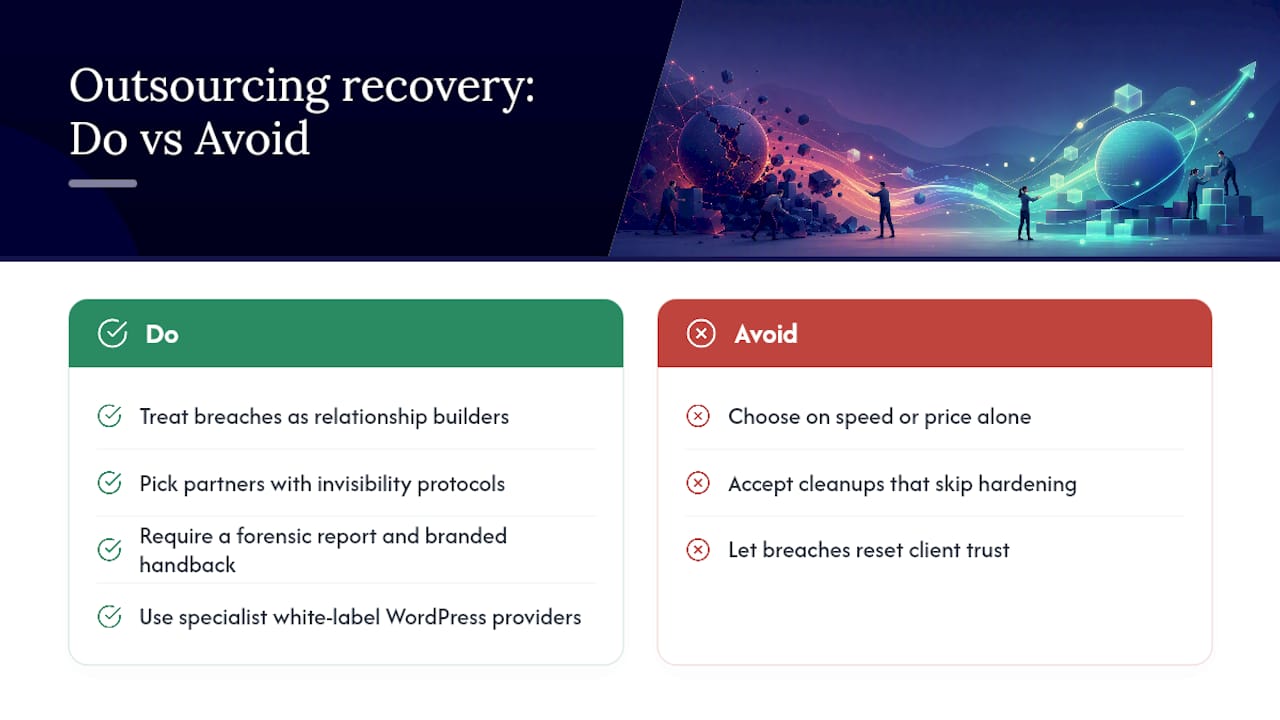
Where agencies genuinely go wrong is choosing a recovery partner on speed and price alone, without checking whether that partner actually operates an invisibility protocol or can produce a real forensic report on request. A cheap, fast clean‑up that skips hardening just resets the clock to the next breach, usually within weeks, and this time it happens on a client relationship you’ve already spent capital rebuilding trust in once.
Specialist WordPress management providers offer white‑label recovery, ongoing maintenance plans, security monitoring, emergency support, and fractional CTO consulting, typically delivered under the agency’s own brand so the agency keeps the client relationship. Full details sit on our white‑label support page and our company background. If you’re evaluating any partner for this work, insist they can show you the same: a forensic report, a branded handback, and proof they’ve done this before.
— Marcel
Get a recovery partner your clients never see
Wpcto exists specifically for agencies who don’t want WordPress emergencies eating into billable hours or Sunday evenings. Unlike hiring a generalist freelancer for each fire, or building an internal WordPress specialism you don’t actually want, Wpcto sits behind your agency invisibly: your branding, your client relationship, your recurring revenue.
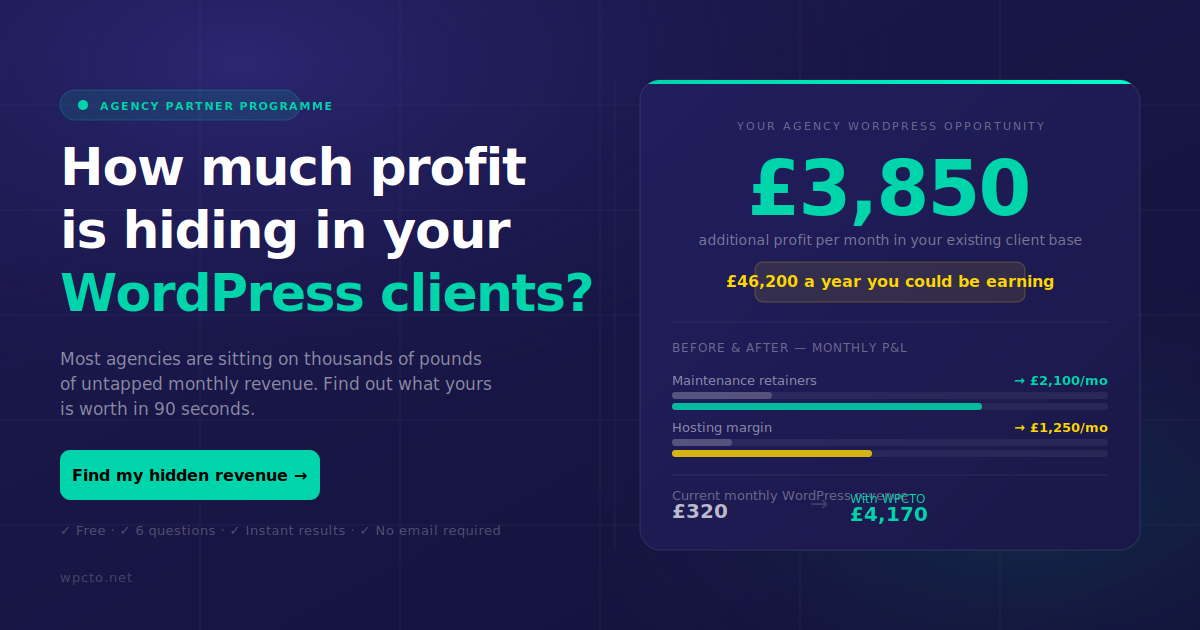
If a client site is compromised right now, our agency services page covers exactly what containment, cleanup, and hardening looks like under your brand. For agencies weighing up whether outsourcing recovery and maintenance actually pays, the WordPress Profit Calculator takes under 90 seconds and shows the recurring revenue sitting uncaptured in your current client base. Run your numbers, then get in touch about a white‑label partnership through our white‑label enquiries page and we’ll take the next hacked‑site call off your desk entirely.