

Outsourcing website tasks is usually the fastest way for an agency or SMB to free up creative capacity, convert fixed costs into variable ones, and bring in specialist skills you’d never justify hiring full time. The main reasons are speed, cost flexibility, access to expertise, and reduced technical risk, but it works best paired with clear scope and quality checks. This piece covers the practical checklists, the numbers, and one editorial view from Marcel on where agencies get outsourcing wrong.
TL;DR:
- Outsourcing transforms fixed WordPress support costs into variable expenses, enabling agencies to scale seamlessly according to demand.
- Clear scope, measurable acceptance criteria, and regular communication are crucial to avoid outsourcing failures and ensure quality outcomes.
- Running small paid pilots and demanding documented SLAs, code access, and QA processes significantly improve partner selection and project success.
- Cost savings are maximized when support volume stays below the threshold where in-house staffing becomes more economical, emphasizing the importance of tracking ROI.
- Strategic tasks like discovery, client sign-off, and relationship management should remain in-house, as outsourcing delivery does not transfer accountability.
Table of Contents
- Top reasons to outsource website tasks
- How outsourcing works in practise for agencies
- Costs and how to measure ROI from outsourcing
- Risks, red flags and what to keep in-house
- Marcel’s perspective: real outcomes from outsourcing WordPress work
- What actually matters when you decide to outsource
- How WPCTO helps agencies free up capacity and margin
- Sources
Top reasons to outsource website tasks
Agencies rarely lose clients because of bad creative work. They lose margin, evenings, and good staff because of WordPress maintenance nobody wanted to own. If you’re weighing up whether to keep website support in-house or hand it to a specialist partner, here’s what actually moves the needle.
1. Access to specialist skills you can’t justify hiring for
WordPress performance tuning, security hardening, and complex plugin integrations are deep specialisms. Most agencies need them occasionally, not constantly, which makes a full-time hire hard to justify financially. Outsourcing gives you access to that expertise on demand, without carrying the salary cost between projects.
2. Fixed headcount becomes variable cost
A permanent WordPress developer costs you the same in a quiet month as a busy one. Outsourcing converts that fixed headcount cost into a variable one, scaling with actual demand rather than sitting on the balance sheet regardless of workload. That single shift is often the difference between a healthy margin and a break-even retainer.
3. Faster delivery through parallel workstreams
A specialist partner running multiple client sites simultaneously can often turn around a fix or a migration faster than a generalist in-house team juggling five other priorities. Some outsourced partners also offer coverage outside standard office hours, which matters when a client’s site goes down at 11pm on a Friday.
4. Scalability that matches lumpy agency demand
Agency workload is rarely smooth. You might onboard three new WordPress clients in a month, then nothing for six weeks. Outsourced teams let you scale delivery up or down without the hiring and firing cycle that permanent staffing forces on you.
5. Mature risk reduction and incident response
Security monitoring, patch management, and incident response are processes, not one-off tasks. A partner running these across dozens of sites daily builds pattern recognition an in-house generalist rarely gets the reps to develop. Formal control frameworks such as AICPA’s SOC standards exist precisely because buyers need evidence that a vendor’s security processes are mature, not just claimed.
6. Free up your best people for the work that actually grows the agency
Every hour your senior designer or account manager spends untangling a plugin conflict is an hour not spent on strategy, pitching, or client relationships. That’s the real cost of “just fixing it ourselves.” Outsourcing the delivery layer gives that time back.
7. A path to recurring revenue via white-label maintenance
If you’re currently fixing WordPress issues for free because “it’s just a small thing,” you’re bleeding margin. A white-label WordPress support arrangement lets you package that same work as a billed retainer, with the specialist partner invisible behind your brand.
8. Lower recruitment and onboarding overhead
Hiring a WordPress developer for a one-off migration means job ads, interviews, onboarding, and eventually redundancy or under-utilisation. Outsourcing skips all of that friction for skills you need in bursts rather than continuously.
Taken together, these reasons explain why outsourcing website management has moved from a cost-cutting tactic to a genuine growth lever for agencies that get the model right.
How outsourcing works in practise for agencies
The operational model matters more than the decision to outsource itself. Get the structure wrong and you’ll blame “outsourcing” for what was actually a bad brief.
Most agency arrangements fall into one of four shapes:
- White-label retainer — a partner handles maintenance and support invisibly, under your brand, billed monthly.
- Dedicated team — a fixed set of specialists work as an extension of your team on an ongoing basis.
- Project-based — a scoped piece of work (a migration, a rebuild) delivered to a fixed brief and price.
- Blended model — a small internal core handles strategy and client relationships while outsourced teams handle execution.
Contracts should nail down IP assignment (you own the code, not the vendor), staged payments tied to milestones, documented SLAs, and guaranteed access to code repositories from day one. Scope clarity, staged payments, and repository access determine whether WordPress outsourcing succeeds far more than which country the partner is based in.
Before committing to a full contract, run a small paid pilot task. It’s the cheapest way to see how a partner handles a real brief, communicates when something goes wrong, and hands work back for QA. If they fumble a £500 test, they’ll fumble a £15,000 project too.
Pro Tip: Write acceptance criteria that are testable, not vague. “Checkout completes in under 3 seconds on 4G” is verifiable. “Site should feel fast” isn’t. Testable criteria remove the arguments before they start.
Communication rhythm is where most outsourcing relationships actually break down, not cost or quality. Communication issues are consistently reported as the top cited outsourcing challenge, ahead of price or skill gaps. A weekly sync, asynchronous ticket updates, and a documented handover process for every completed job solve most of it before it becomes a problem.
Costs and how to measure ROI from outsourcing
Swapping an in-house salary for a vendor fee changes more than the headline number. You lose the fixed cost of a salary, benefits, and desk space, but you take on new management overhead: onboarding a partner, running QA, and coordinating handovers.
The break-even calculation is usually about volume. Below a certain number of WordPress sites or support tickets a month, outsourcing wins on cost every time because you’re not paying for idle capacity. Above that threshold, a well-managed in-house hire can start to compete, but only if your ticket volume is consistent enough to keep them fully utilised.
Track four numbers to know if outsourcing is actually working for you:
- Average cost per deliverable (a fixed migration, a plugin update, a support ticket)
- Time to delivery against your SLA
- Ticket volume trends month on month
- Client satisfaction or NPS for sites under management
The number most agencies never calculate: the uncaptured margin sitting in the WordPress maintenance work they’re already doing for free or underpricing. Run the WPCTO WordPress Profit Calculator against your current client base. It takes under 90 seconds and shows exactly how much recurring revenue you’re leaving on the table by not billing maintenance as its own service line.
Risks, red flags and what to keep in-house
Outsourcing fails for predictable reasons, and almost none of them are “the vendor was based in the wrong country.” The real failure modes are vague briefs with no measurable acceptance criteria, no QA step before work goes live, single-vendor dependency with no fallback, and IP terms buried in a contract nobody read properly.
Watch for these red flags when vetting a potential partner:
- No clear process for staging, testing, and QA before deployment.
- Reluctance to grant you repository access or explain IP ownership terms.
- No documented SLA for response times or incident handling.
- Pricing that’s vague about what’s included versus billed as an extra.
- No willingness to start with a small paid pilot task.
Selecting an outsourcing partner on process and communication quality, not price alone, avoids rework and poor outcomes far more reliably than chasing the cheapest quote.
Some work should stay firmly in-house regardless of how good your outsourcing partner is: discovery conversations with clients, strategic decisions about a site’s direction, final sign-off before anything ships, and ownership of the client relationship itself. Outsourcing delivery is not the same as outsourcing accountability.

Marcel’s perspective: real outcomes from outsourcing WordPress work
Working across agencies of every size, the pattern repeats constantly: a talented creative team loses whole afternoons to plugin conflicts, hosting migrations, or a client’s “urgent” broken contact form. None of that work uses the skills the agency was hired for.
The agencies that get outsourcing right don’t see it as losing control. They see it as choosing where their control actually matters. Client strategy stays theirs. The plugin update queue doesn’t need to.
White-label arrangements solve the awkward bit: the client never needs to know a specialist partner is behind the scenes. The agency keeps the relationship and the billing; the partner handles the delivery.
| Typical task handed off | Why agencies outsource it |
|---|---|
| Plugin and core updates | Recurring, time-consuming, low creative value |
| Emergency site fixes | Requires availability agencies rarely staff for |
| Site migrations | Technically risky, infrequent, high stakes |
| Ongoing maintenance retainers | Better run as a specialist’s core service than a side task |
Run your own numbers through the Profit Calculator before deciding either way. It tends to surprise people.
— Marcel
What actually matters when you decide to outsource
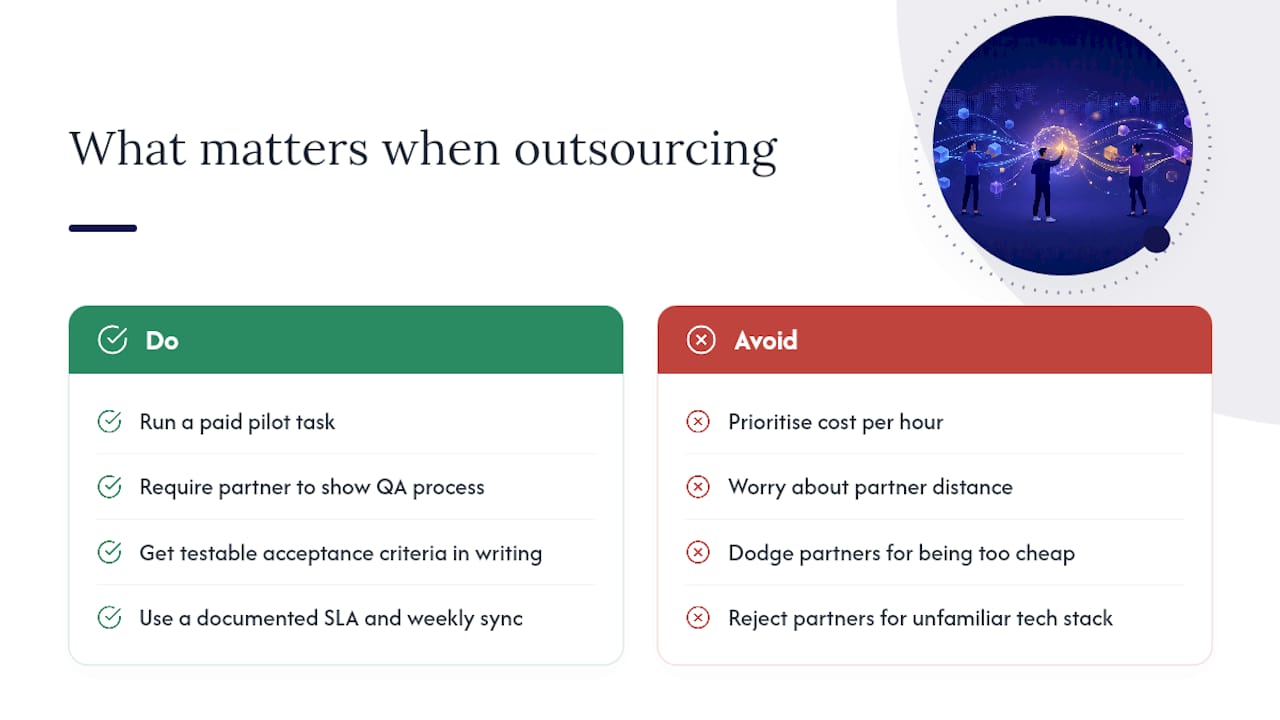
The research on this is fairly consistent, and most of it points away from the conventional advice. Agencies are told to worry about outsourcing partners being too far away, too cheap, or too unfamiliar with their tech stack. In practice, the thing that sinks these relationships almost every time is a vague brief paired with no QA checkpoint. Geography barely features.
The overrated concern is control. Handing off delivery doesn’t mean losing it. A documented SLA and a weekly sync often give you more visibility into what’s actually happening on your client sites than the informal “someone will get to it” system most agencies run internally.
If you take one thing from this: don’t evaluate outsourcing by cost per hour first. Evaluate it by whether the partner will run a paid pilot task, show you their QA process, and put testable acceptance criteria in writing. That tells you more about the relationship’s future than any rate card.
How WPCTO helps agencies free up capacity and margin
Everything above points to the same conclusion: the agencies protecting their margin best are the ones who’ve stopped treating WordPress maintenance as a side task their designers absorb between projects. Wpcto exists specifically for that gap. Specialist partners can run white-label WordPress support, security monitoring, performance work, hosting management, migrations, and emergency fixes behind your brand, on SLA-backed terms, so your team never touches a support ticket again.
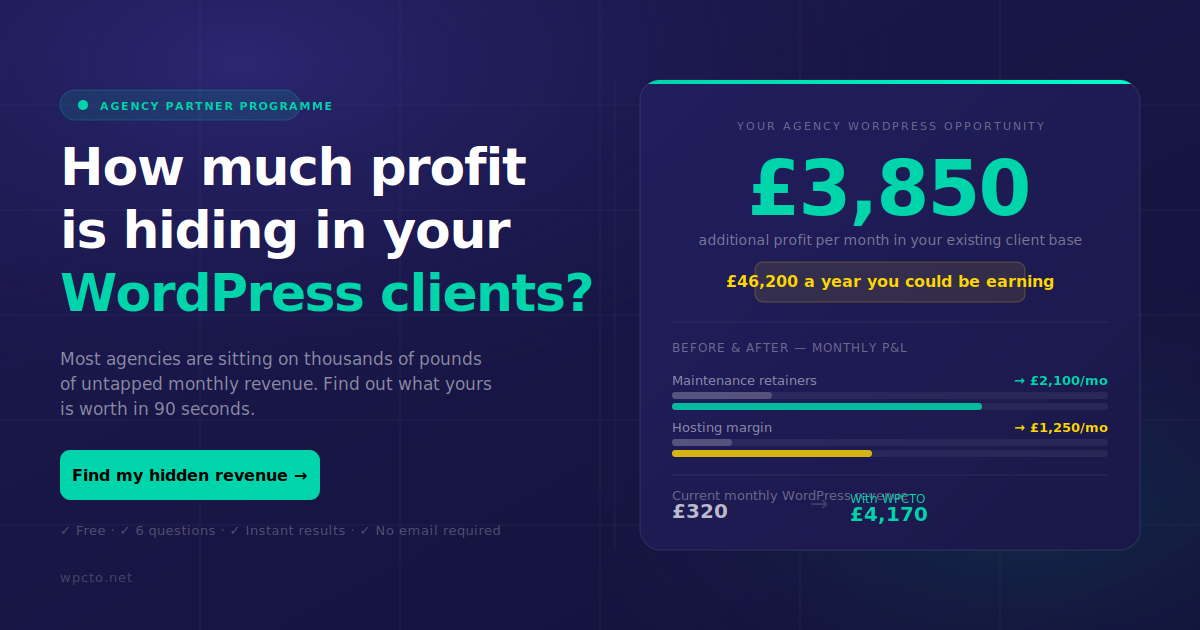
If you’re not sure how much this is actually worth to your agency, that’s exactly what the WPCTO WordPress Profit Calculator is for. Put your current client count and support workload in, and in under 90 seconds you’ll see the uncaptured margin sitting in your existing WordPress book. Run the numbers, then book a short discovery call to talk through what a white-label retainer would actually look like for your client base.
Sources
- Outsource web development for agencies: how to scale without hiring – Agency Stack Global
- In-house vs outsourced web development: which is better for agencies? – Innovacious
- Outsourcing WordPress development for agencies – Gautam Khorana
- IT outsourcing for digital agencies – Workstatus