

Delegating WordPress maintenance is worth it for most agencies that never wanted to become a WordPress shop in the first place. The three benefits that matter most are reclaimed internal hours, lower operational risk from security and update failures, and better margins from swapping fixed payroll for variable, outcome-based costs. Wpcto and its WordPress Profit Calculator give you a fast way to see what that’s worth in your own client book.
TL;DR:
- Outsourcing WordPress support can free up to 55 hours per month, preventing emergency tickets and allowing teams to focus on strategic tasks.
- Delegation enables agencies to scale from 12 to 30 clients within eight months without additional in-house staff or fixed payroll costs.
- Working with a structured white-label partner ensures consistent quality, transparent SLAs, and client relationships remain fully in the agency’s control.
- Estimated annual savings from outsourcing can reach about £84,000 compared to hiring an additional senior developer, with faster delivery reducing rework and disputes.
- Using a simple calculator helps agencies quickly measure potential revenue from delegation and justifies the switch to managed WordPress support.
Table of Contents
- What are the benefits of website delegation for agencies?
- How does white-label delegation actually work?
- What ROI can agencies actually expect from delegation?
- How do you choose the right delegation partner?
- Why agencies underestimate how much delegation actually gives back
- How Wpcto helps agencies delegate with confidence
- Sources
What are the benefits of website delegation for agencies?
The advantages of website delegation show up first in your team’s calendar. Account managers stop fielding Friday-afternoon “the site’s down” calls, and developers stop losing half a sprint to a client’s plugin conflict. One agency partner featured in a TopSyde case study reclaimed a significant amount of time each month after outsourcing WordPress operations, alongside a notable jump in average mobile PageSpeed score, with zero client-reported incidents over the following year.
That kind of shift changes what your team is actually paid to do.
- Reclaimed time: fewer emergency tickets means account managers spend their week on strategy calls, not server panic.
- Predictable capacity: you can take on five new WordPress clients without hiring a single extra developer.
- Better uptime and performance: dedicated monitoring catches slow queries and outdated plugins before a client notices.
- Stronger margins: fixed payroll becomes a variable cost that scales with revenue, a shift outsourcing specialists at TeamOnTime point to as one of the clearest financial gains of moving support off the internal team.
- Faster delivery: staged testing and conflict checks before anything goes live cut down on the rework that eats billable hours.
- Protected client relationships: white-label delivery means the client still sees your agency name on every invoice and every email.
Reclaimed time isn’t a soft benefit. Fifty-five hours a month is close to a full extra working week, recovered without a single new hire.
A second case, documented by HackProofWP, shows an agency scaling from 12 to 30 WordPress clients in eight months using a white-label partner, saving a substantial amount annually compared to hiring a mid-level developer. That’s the pattern worth paying attention to: growth in client count without a parallel growth in headcount.
Pro Tip: Track how many hours your account managers spend on WordPress fire drills for one month before you delegate anything. That baseline number is the only way to prove the change actually worked.
How does white-label delegation actually work?
A structured delegation partner runs on a repeatable process, not ad hoc firefighting. The mechanics matter more than the marketing copy, because this is where quality either holds or slips.
- Staging first, always. Every update, plugin change, or theme tweak gets tested on a staging copy of the site before it touches production, with a rollback plan ready if something breaks.
- Batched, monitored updates. Core, plugin, and theme updates run on a schedule rather than reactively, with conflict checks built into the process rather than discovered by the client.
- Scoped account access. Your team gets a client portal or dashboard showing health scores and monthly reports, so you can see what’s happening without needing to log into every site yourself.
- Named contacts and SLA windows. You should know exactly who handles your accounts and what response time applies when something breaks at 11pm on a Saturday.
- White-label or named-partner delivery. Some agencies want the partner to stay entirely invisible to the client; others are happy naming a trusted technical partner. Either way, the client relationship, the invoicing, and the account ownership stay with you.
Partners who structure delivery this way, as outlined in HackProofWP’s scaling case study, tend to avoid the two most common outsourcing failures: inconsistent quality across sites, and clients accidentally discovering a third party is involved.
What ROI can agencies actually expect from delegation?
The financial case for delegating WordPress work comes down to three numbers: hours saved, cost avoided, and rework reduced. None of these are guesswork if you have decent baseline data on your current support load.
| Metric | In-house senior developer | Managed delegation partner |
|---|---|---|
| Annual cost | Salary plus overheads, fixed regardless of workload | Variable, scales with client count |
| Capacity | Fixed to one person’s working hours | Flexible across multiple accounts |
| Client scaling | Requires new hire to grow further | Scaled from 12 to 30 clients in 8 months without new headcount |
| Estimated annual saving | Baseline | Roughly £84,000/year versus a hire, per the same case |
Beyond the headline saving, there are quieter financial benefits. Faster, staged delivery means fewer emergency credits issued to frustrated clients. Cleaner billing cadences mean fewer disputed invoices over unplanned fix time. And with WordPress powering a large share of the web, maintenance demand across your client portfolio isn’t shrinking. It’s a recurring cost centre whether you manage it internally or not.
Outsourcing operations converts a fixed cost into a variable one, and that single change is often what makes agency growth financially viable rather than just aspirational, according to TeamOnTime’s analysis.
The fastest way to see what these numbers mean for your specific client list is to run them through the WordPress Profit Calculator. It takes under 90 seconds, and it’s worth saving the result before your next partnership conversation.
How do you choose the right delegation partner?
Vetting a WordPress delegation partner properly takes one conversation and one small paid test, not months of due diligence. Ask direct questions and expect direct answers.
On operations, confirm they run staging environments, automated backups, and active monitoring, and ask them to walk you through their rollback process if an update breaks a live site. On commercial terms, get clear SLA response times in writing, understand exactly how billing works, and confirm code ownership stays with you or your client, not the partner.
- Ask for a live staging URL you can inspect, not just a sales deck.
- Request a sample monthly report so you know what your clients (or you) will actually see.
- Ask for a contactable existing agency client as a reference.
- Watch for vague scopes and no mention of code review; that combination is where most outsourced WordPress work goes wrong, according to Gautam Khorana’s analysis of outsourcing failures.
Pro Tip: Before signing anything long-term, run a single paid test task, such as a plugin update or a one-page performance tune, for around £300 to £500. It reveals more about a partner’s real capability than any pitch call.
Why agencies underestimate how much delegation actually gives back
Most agency owners think delegating WordPress support is about avoiding hassle. That’s true, but it undersells the point. The real shift happens on the P&L, not the to-do list.
Agencies that hold onto WordPress support internally are effectively running two businesses: the creative one they were hired to run, and an unofficial hosting company nobody budgeted for. The strongest agencies I’ve seen operate delegate early and delegate small, starting with a single client or a single service tier, then expanding once the model proves itself. That’s a far lower-risk path than an all-or-nothing switch.
Keep the client relationship in your hands through white-label delivery, and quantify the change properly using the WordPress Profit Calculator before and after. Numbers convince partners and stakeholders far better than a feeling that things are running smoother.
— Marcel
How Wpcto helps agencies delegate with confidence
An alternative to hiring an in-house WordPress developer or absorbing support work you never priced for is to use an external service that handles maintenance plans, security monitoring, performance optimisation, plugin and theme management, hosting, migrations, emergency support, and fractional CTO consulting, all delivered white-label so your clients only ever see your agency’s name, leveraging WordPress publishing automation for content teams to streamline operations.
Every engagement runs on staged testing, named contacts, and SLA-backed response times, so you always know who owns what and when they’ll respond. You keep the client relationship, the billing, and the credit for the work. We stay behind the scenes.
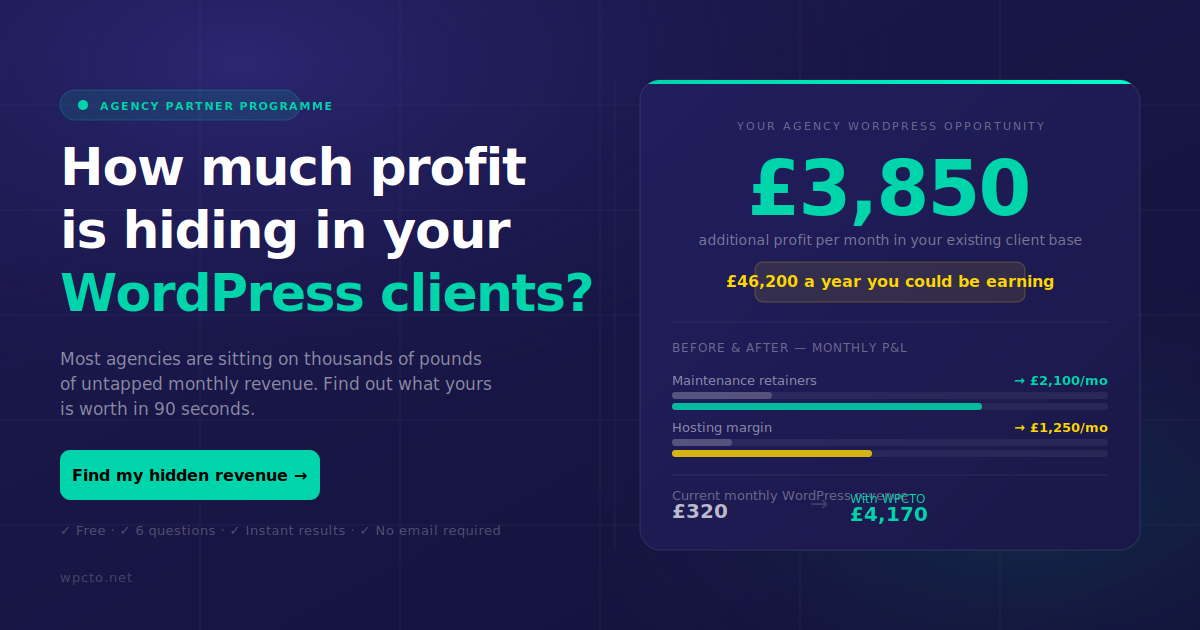
The most useful first step is the WordPress Profit Calculator: it takes under 90 seconds to see exactly how much uncaptured revenue is sitting in your existing WordPress client base. Run it, save your number, then get in touch with Wpcto about our agency services to talk through what delegating that workload would actually look like for your team.
Sources
- Fresh Ground Thinking — They got 55+ hours a month back — without hiring a single ops person. — TopSyde
- Why Agencies Outsource WordPress Development Instead of Hiring In-House | TeamOnTime OS
- Outsourcing WordPress Development for Agencies